
A tangent vector describes an instantaneous change of a rotation: the direction in which the rotation changes and the rate of that change. It is attached to one rotation \(R\), called its base point. The collection of all tangent vectors attached to \(R\) is the tangent space at \(R\).
This page assumes the active rotations introduced in Defining Rotations and the multiplication order explained in Calculating with Rotations. Spin Tensors develops the continuum-mechanics interpretation of an instantaneous rotation.
Tangent vectors provide local, three-component coordinates for the curved rotation group SO(3). MTEX uses them for derivatives, gradients, and vector fields on SO(3), and for finite updates through the exponential map.
plottingConvention.default('y↑→x');Left and Right Representations
A tangent vector at \(R\) is a \(3 \times 3\) matrix, but it can be described by only three numbers. Those numbers form a skew-symmetric matrix \(S\). The skew-symmetric matrix can multiply \(R\) from the left or from the right:
\[ T = S_{\rm left} R = R S_{\rm right}. \]
These are two coordinate representations of the same tangent vector, not two different tangent spaces. In MTEX the left coordinates are expressed in the specimen frame and the right coordinates in the crystal frame.
R = rotation.byAxisAngle(vector3d.X,20*degree);
SLeft = spinTensor(vector3d(0,0,1));
SRight = spinTensor(vector3d(0,sin(20*degree),cos(20*degree)));

tangentLeft = matrix(SLeft) * matrix(R);
tangentRight = matrix(R) * matrix(SRight);

max(abs(tangentLeft-tangentRight),[],'all')
ans =
5.5511e-17The residual is at round-off level, so both products describe the same tangent matrix. The coordinates in SLeft and SRight differ because their bases differ.
Tangent Vectors in MTEX
MTEX stores the coordinates, the base point, and the left or right representation in an SO3TangentVector. The base point is an orientation, so it is also the single source of any crystal and specimen symmetries carried by the tangent vector.
components = 0.2*vector3d(1,2,3);
vLeft = SO3TangentVector(components,R)
vLeft = SO3TangentVector (y↑→x)
intern symmetries: 1 → y↑→x
tangentSpace: leftVector
x y z
0.2 0.4 0.6The display identifies vLeft as a leftVector and prints its three specimen-frame coordinates. The default representation is left.
A tangent vector is drawn as an arrow attached to its base point.
plot(R,'axisAngle','MarkerColor','red')
axis off
hold on
quiver3(vLeft,'LineWidth',3,'maxHeadSize',4)
hold off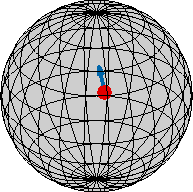
The red marker is the base rotation \(R\). The blue arrow is a local direction at that point, not a second rotation in the surrounding space. Moving the same three coordinates to another base point would therefore define a different tangent vector.
Changing Representation
Giving the same coordinates to the right-vector constructor does not convert vLeft. It defines a different tangent vector whose coordinates happen to be the same numbers.
vSameCoordinates = SO3TangentVector(components,R,...
  SO3TangentSpace.rightVector)
vSameCoordinates = SO3TangentVector (crystal)
intern symmetries: 1 → y↑→x
tangentSpace: rightVector
x y z
0.2 0.4 0.6The rightVector label in the display is the essential difference. To express vLeft itself in right coordinates, use right.
vRight = right(vLeft)vRight = SO3TangentVector (crystal)
intern symmetries: 1 → y↑→x
tangentSpace: rightVector
x y z
0.2 0.581 0.427The transformed coordinates differ from those of vLeft, while the base point and the geometric tangent vector stay fixed. The inverse conversion returns to the original coordinates.
vLeftAgain = left(vRight);
norm(vLeftAgain-vLeft)
ans =
5.5511e-17Computing with Tangent Vectors
MTEX converts compatible tangent vectors to a common representation before performing arithmetic. Thus adding vLeft to its right-coordinate representation gives twice the original vector.
vLeft + vRightans = SO3TangentVector (y↑→x)
intern symmetries: 1 → y↑→x
tangentSpace: leftVector
x y z
0.4 0.8 1.2The following operations are available for tangent vectors v1 and v2 at the same base point:
- sums, differences, scaling, and division
- inner products with
dot(v1,v2) - cross products with
cross(v1,v2) - lengths with
norm(v1) - normalization with
normalize(v1) - averages with
mean(v1)
The last three operations use the vector operations inherited by SO3TangentVector. Arithmetic is defined only for tangent vectors at the same base point and with compatible symmetries.
Exponential and Logarithm Maps
The exponential map follows a tangent direction for the finite angular step stored in the vector norm. It returns the endpoint on SO(3).
R2 = exp(vLeft);The logarithm map reverses this construction. Given the endpoint first and the base point second, log returns the tangent vector at the base point that leads to the endpoint.
vBack = log(R2,R);
norm(vBack-vLeft)
ans =
1.8619e-16The displayed residual confirms the round trip to numerical precision. Rotation logarithms use a principal branch. At a relative angle of \(180^\circ\) the rotation axis, and therefore the logarithm, is not unique.
Together, log and exp let an algorithm compute a local change in a flat tangent space and apply that change back on the curved rotation group. This is the pattern behind interpolation, averaging, and optimization of rotations.
The Maths Behind the Two Representations
The tangent space at \(R\) is
\[ T_R SO(3) = \{S R \mid S=-S^T\} = \{R S \mid S=-S^T\}. \]
The set of skew-symmetric matrices is the Lie algebra \(\mathfrak{so}(3)\). Therefore the two equal descriptions are also written \(\mathfrak{so}(3)R\) and \(R\mathfrak{so}(3)\). Equating the tangent matrices gives the coordinate change
\[ S_{\rm right}=R^{-1}S_{\rm left}R. \]
The methods right and left apply this change of basis. They do not move the base point or change the geometric tangent vector.
References
- A. Morawiec, Orientations and Rotations: Computations in Crystallographic Textures, Springer, 2004, develops the geometry of rotation space and small orientation changes for texture analysis.
- P.-A. Absil, R. Mahony, and R. Sepulchre, Optimization Algorithms on Matrix Manifolds, Princeton University Press, 2008, introduces tangent-space methods and exponential updates for optimization on matrix manifolds.
- R. Hartley, J. Trumpf, Y. Dai, and H. Li, Rotation Averaging, International Journal of Computer Vision 103 (2013) 267--305, compares rotation-space metrics and averaging methods.
Next
Spin Tensors develops the skew-symmetric matrix description as a rate of rotation in a deforming material. With crystal and specimen symmetries attached, tangent vectors become vector fields on SO(3).
Citing this page.
This page is part of the documentation of
MTEX, a free and open
source MATLAB toolbox for analyzing and modeling crystallographic textures.
It was written by The MTEX Developers and is published at
https://mtex-toolbox.github.io/RotationTangentSpace.html.
If you use MTEX, or reuse text or figures from this page, in your research,
please cite
F. Bachmann, R. Hielscher, H. Schaeben: Texture Analysis with MTEX - Free and Open Source Software Toolbox, Solid State Phenomena 160 (2010), 63-68. 10.4028/www.scientific.net/SSP.160.63
BibTeX
@article{bachmann2010mtex,
  author  = {F. Bachmann and R. Hielscher and H. Schaeben},
  title   = {Texture Analysis with MTEX - Free and Open Source Software Toolbox},
  journal = {Solid State Phenomena},
  volume  = {160},
  pages   = {63-68},
  year    = {2010},
  doi     = {10.4028/www.scientific.net/SSP.160.63},
  url     = {https://doi.org/10.4028/www.scientific.net/SSP.160.63}
}
Other papers describing specific MTEX methods are listed under Publications — please cite the one that best fits your application. The MTEX source code is licensed under the GNU General Public License v2.0; the text and figures of this documentation are licensed under CC BY 4.0, which permits reuse — including by automated systems — provided The MTEX Developers and this page are credited.