
A spherical function has no preferred flat view. The useful plot depends on the question being asked.
Use colour for values and contours for level sets. Use three-dimensional shape, a planar section, or harmonic content for other questions.
This page compares these views. Its examples use objects from Concept and Operations.
Example functions
The examples use the smiley function for recognisable spatial features and an oscillatory function for a more revealing planar section.
% the smiley
plottingConvention.default('y↑→x');
sF1 = S2Fun.smiley;

% some oscillatory function
f = @(v) 0.1*(v.theta+sin(8*v.x).*sin(8*v.y));
sF2 = S2FunHarmonic.quadrature(f,'bandwidth',150);
Smooth colour plot
pcolor draws function values as colour without contour lines. The more general plot command produces the same default view.
plot(sF1)
mtexColorbar('title','function value')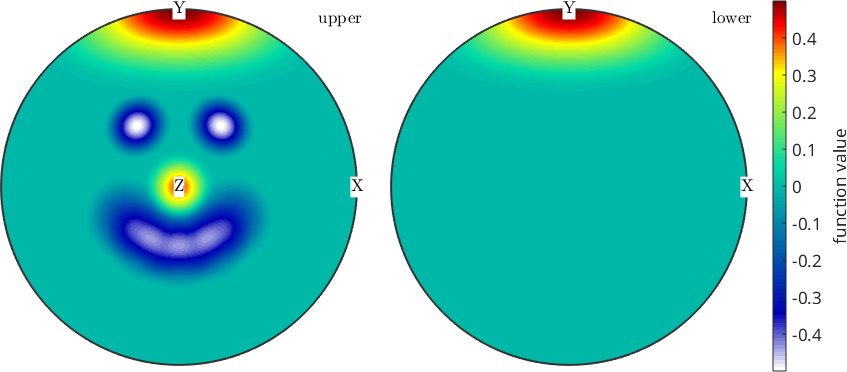
The eyes and mouth appear as smooth colour regions. This view makes the spatial pattern easy to recognise, and the colour bar translates colour into function value. The plot does not mark particular value levels.
Contour plots
contour draws level lines. contourf fills the regions between those lines.
newMtexFigure('layout',[1,2]);
contour(sF1,'upper')
mtexTitle('Contour lines')
nextAxis(1,2)
contourf(sF1,'upper')
mtexTitle('Filled contours')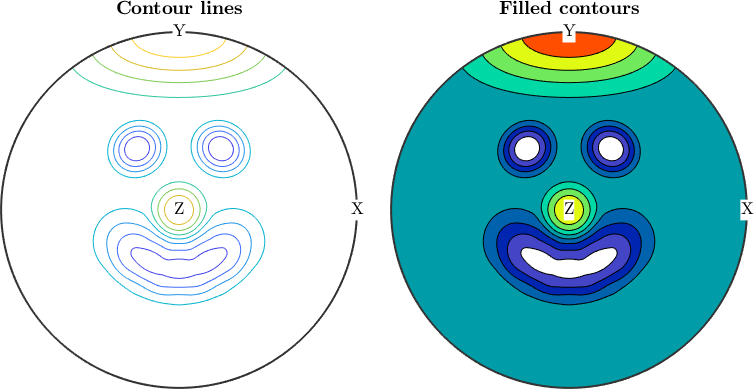
Both panels trace the same levels on the upper hemisphere. The filled view makes their ordering easier to read, while the line view leaves the underlying area unobscured.
Freely rotatable 3D plot
plot3d draws a three-dimensional view that can be rotated freely with the mouse in an interactive MATLAB figure.
plot3d(sF1)
mtexTitle('Values on the sphere')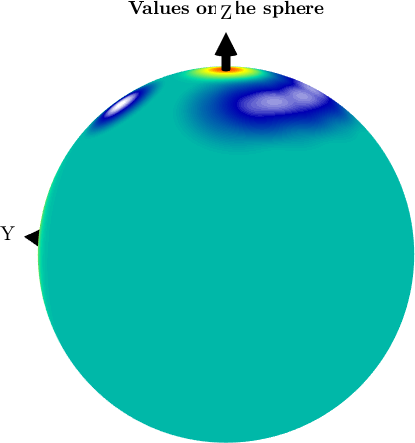
Here the radius stays fixed and colour carries the function value. This view reveals how features continue around the sphere without changing the geometry to encode amplitude.
Set the 3D camera
A plotting convention specifies how a reference frame is laid out on screen. Its north and outOfScreen directions provide a reproducible camera for the static published view.
how2plot = plottingConvention;
how2plot.north = yvector;
how2plot.outOfScreen = vector3d(1,0,2);
setCamera(how2plot)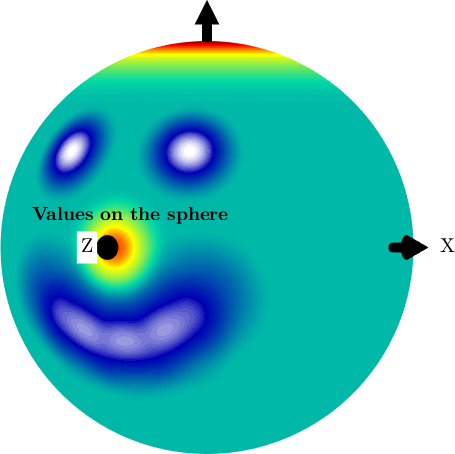
The camera now places the \(y\) direction at the top and looks along the specified combination of the \(x\) and \(z\) directions. The function itself has not been rotated.
Radial surface plot
surf transforms the radius of the sphere according to the function value. Colour and radial displacement therefore encode the same value. By default MTEX rescales a real scalar function before using it as radius. The rescaling keeps relative variation visible.
surf(sF1)
axis off
setCamera(how2plot)
mtexTitle('Values as radius and colour')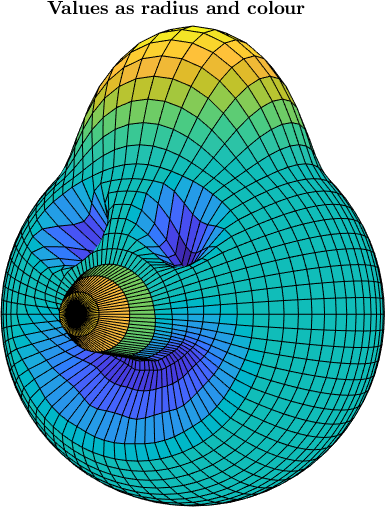
Peaks extend farther from the centre, while low values pull the surface inward. The camera is unchanged, so this shape can be compared directly with the previous three-dimensional view.
The 'noScaling' flag skips the default rescaling. In that case the radial distance is the absolute function value, which is useful only when the original magnitude makes a readable surface.
Planar section
plotSection draws the intersection of the radial surface with a plane. The normal vector N selects that plane.
N = zvector;
plotSection(sF2,N,'color','interp','linewidth',10)
colormap spring
mtexTitle('Section in the xy plane')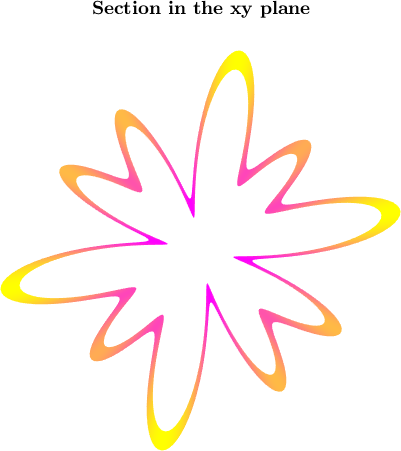
With N = zvector, the section lies in the \(xy\) plane. The repeated lobes expose the oscillation from the sine factors more clearly than a single projected hemisphere would.
Harmonic spectrum
plotSpektra groups the spherical harmonic coefficients by degree. This view describes frequency content rather than position on the sphere.
close all
plotSpektra(sF1,'FontSize',15,'linewidth',2,'figSize','small')
xlim([0,40])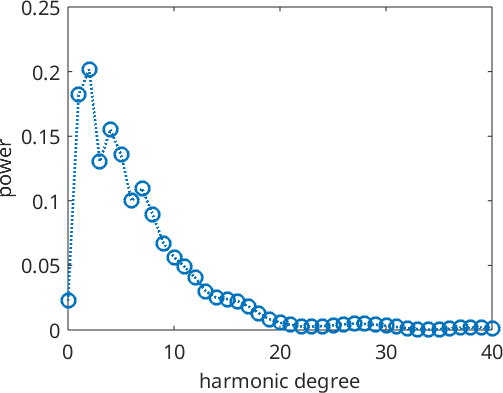
Low degrees describe broad variation. The non-zero coefficients at higher degrees supply the sharper facial details. The horizontal axis is limited to degree 40 so that this useful part of the spectrum is legible.
Choose a view
Use a smooth colour plot to locate values. Use contours to compare levels. Use a radial surface to emphasise amplitude. A section isolates one plane. The spectrum reveals harmonic scale. The linked method pages list the more specific plot options for each representation.
close allReferences
- F. Bachmann, R. Hielscher and H. Schaeben, Texture Analysis with MTEX - Free and Open Source Software Toolbox, Solid State Phenomena 160, 63--68, 2010. This article shows how MTEX visualises directional quantities in texture analysis.
Next
Continue with Approximation and Interpolation to construct a spherical function from values at discrete directions and compare the available representations.
Citing this page.
This page is part of the documentation of
MTEX, a free and open
source MATLAB toolbox for analyzing and modeling crystallographic textures.
It was written by The MTEX Developers and is published at
https://mtex-toolbox.github.io/S2FunPlotting.html.
If you use MTEX, or reuse text or figures from this page, in your research,
please cite
F. Bachmann, R. Hielscher, H. Schaeben: Texture Analysis with MTEX - Free and Open Source Software Toolbox, Solid State Phenomena 160 (2010), 63-68. 10.4028/www.scientific.net/SSP.160.63
BibTeX
@article{bachmann2010mtex,
  author  = {F. Bachmann and R. Hielscher and H. Schaeben},
  title   = {Texture Analysis with MTEX - Free and Open Source Software Toolbox},
  journal = {Solid State Phenomena},
  volume  = {160},
  pages   = {63-68},
  year    = {2010},
  doi     = {10.4028/www.scientific.net/SSP.160.63},
  url     = {https://doi.org/10.4028/www.scientific.net/SSP.160.63}
}
Other papers describing specific MTEX methods are listed under Publications — please cite the one that best fits your application. The MTEX source code is licensed under the GNU General Public License v2.0; the text and figures of this documentation are licensed under CC BY 4.0, which permits reuse — including by automated systems — provided The MTEX Developers and this page are credited.