
A quasicrystal is an aperiodic crystal with long-range order. Five- or tenfold symmetry is common, but forbidden rotational symmetry is not part of the definition.
A periodic lattice admits only one-, two-, three-, four- and sixfold rotation axes. An icosahedral quasicrystal can therefore have point symmetry that is not among the 32 crystallographic point groups.
This page shows how to supply such a finite point group to MTEX. It covers point symmetry only; it does not model quasiperiodic translations or the higher-dimensional indexing used in quasicrystal structure analysis. Read Crystal Symmetries and Fundamental Sector before this page.
plottingConvention.default('y↑→x');Build the Proper Icosahedral Group
crystalSymmetry.byElements repeatedly composes the supplied operations until they close into a group. The generators must describe a finite group; arbitrary rotations need not do so.
The proper icosahedral group is the rotation group of both the icosahedron and the dodecahedron. One fivefold rotation and one threefold rotation generate it. Their axes are written in the crystal frame.
phi = (1 + sqrt(5)) / 2;

fiveFoldAxis = normalize(vector3d(0,1/phi,1));
rot5 = rotation.byAxisAngle(fiveFoldAxis,72*degree);

threeFoldAxis = normalize(vector3d(1/phi^2,0,1));
rot3 = rotation.byAxisAngle(threeFoldAxis,120*degree);

cs = crystalSymmetry.byElements([rot5,rot3])
cs = crystalSymmetry (⊙c→a)
symmetry : unknown
elements : 60
a, b, c : 1, 1, 1
alpha, beta, gamma: 90°, 90°, 90°
reference frame :The summary reports 60 elements. These are all proper rotations, so this is the chiral icosahedral group rather than the group with inversion.
plot(cs,'symbolSize',0.5,'projection','eangle','grid','on')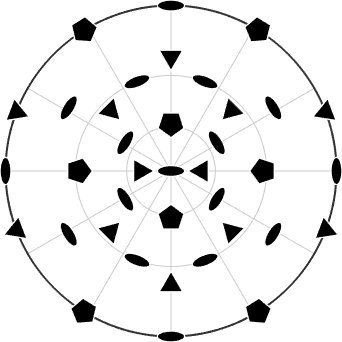
The pentagons mark six fivefold axes, the triangles mark ten threefold axes, and the lenses mark fifteen twofold axes. Opposite ends of an axis represent the same rotation axis.
Reduce Directions and Orientations
Most MTEX algorithms ask a symmetry for its elements rather than for a crystallographic name. Direction and orientation reductions therefore also work for this custom group.
A fundamental sector contains one representative of each general direction family. The proper icosahedral group has 60 elements, so its sector covers one sixtieth of the sphere.
hold on
plot(cs.fundamentalSector,'color','red')
hold off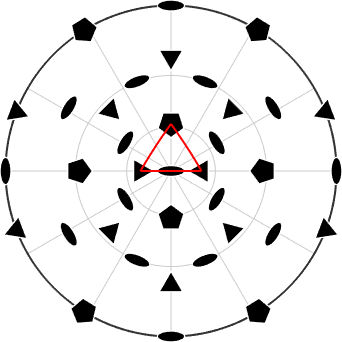
The red spherical triangle is bounded by three great circles. It is the non-crystallographic counterpart of the cubic fundamental sector.
The corresponding fundamental region in orientation space is a dodecahedron. Its twelve faces separate the region from twelve neighbouring symmetry-equivalent copies.
oR = cs.fundamentalRegion;
plot(oR)
axis off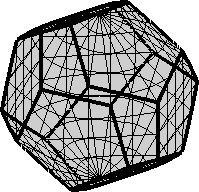
The heavy outer edges reveal the twelve-faced region. The finer curves are the axis-angle coordinate grid drawn on its faces.
Build an Inverse Pole Figure Colour Key
An ipfHSVKey assigns a colour to each direction in the fundamental sector. For an EBSD orientation, the key first expresses its chosen specimen direction in the crystal frame and then colours the resulting crystal direction.
ipfKey = ipfHSVKey(cs);

plot(ipfKey,'complete','upper','resolution',0.5*degree,'noLabel')
hold on
plot(cs,'symbolSize',0.6)
hold off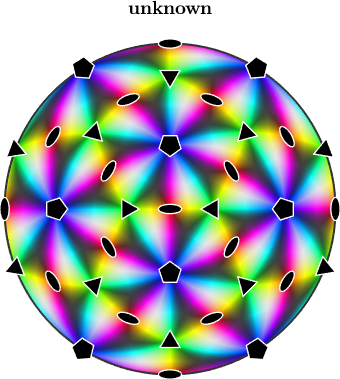
The upper hemisphere shows the colours repeated over the symmetry-equivalent sectors visible there. An EBSD map of a quasicrystalline phase can use this key in the same way as a crystallographic IPF key.
Align the Fivefold Axis with the Crystal Frame
A crystal frame is the Cartesian reference frame in which the symmetry axes are expressed. Changing the axes below changes their alignment in that frame, not the abstract group.
Here the fivefold axis is placed along \(\mathbf{z}\). The threefold axis is placed at the angle between the original generators, \(37.377^\circ\).
rot5 = rotation.byAxisAngle(vector3d.Z,72*degree);
rot3 = rotation.byAxisAngle(...
  vector3d.byPolar(37.377*degree,0),120*degree);

cs = crystalSymmetry.byElements([rot5,rot3])
cs = crystalSymmetry (⊙c→a)
symmetry : unknown
elements : 60
a, b, c : 1, 1, 1
alpha, beta, gamma: 90°, 90°, 90°
reference frame :The summary still reports 60 elements, confirming that only the alignment changed.
plot(cs,'symbolSize',0.5,'projection','eangle','grid','on')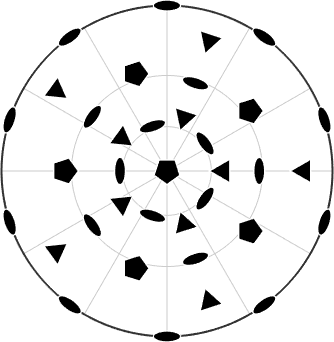
The central pentagon shows that the plot now looks directly down the fivefold axis. The surrounding threefold and twofold axes have rotated with it.
Add Inversion
Many commonly studied icosahedral quasicrystals are centrosymmetric. Adding rotation.inversion combines every proper rotation with inversion.
cs = crystalSymmetry.byElements([rot5,rot3,rotation.inversion])cs = crystalSymmetry (⊙c→a)
symmetry : unknown
elements : 120
a, b, c : 1, 1, 1
alpha, beta, gamma: 90°, 90°, 90°
reference frame :The summary now reports 120 elements: 60 proper and 60 improper operations. It does not report 120 physical rotations.
plot(cs,'symbolSize',0.6,'mirrorLineWidth',2)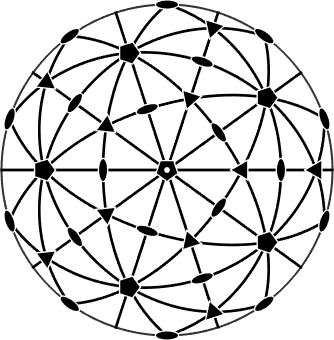
The hollow circle at the centre marks inversion. The great circles mark mirror planes produced by combining inversion with twofold rotations.
ipfKey = ipfHSVKey(cs);
plot(ipfKey,'complete','resolution',0.5*degree,'noLabel')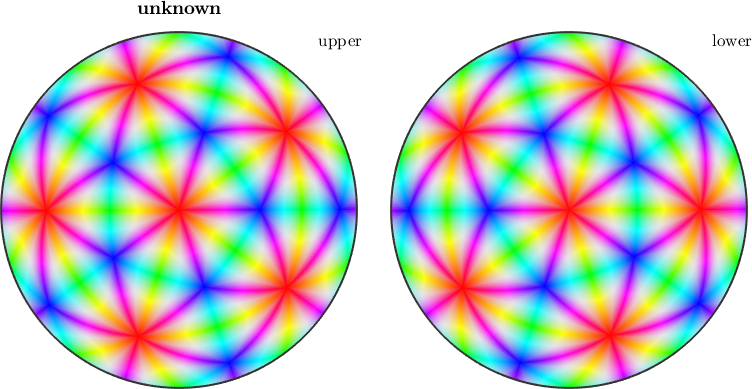
The upper- and lower-hemisphere panels now carry the same colour pattern. Inversion identifies every direction with its opposite, as explained in Axes and Antipodal Symmetry.
Further Reading
- The IUCr Online Dictionary of Crystallography defines quasicrystals and explains why forbidden rotational symmetry is common but not required.
- Th. Hahn, H. Klapper, U. Mueller, and M. I. Aroyo, Point groups and crystal classes, International Tables for Crystallography A, ch. 3.2, 2016, treats crystallographic and non-crystallographic point groups.
- D. Shechtman, I. Blech, D. Gratias, and J. W. Cahn, Metallic phase with long-range orientational order and no translational symmetry, Physical Review Letters 53, 1951-1953, 1984, reports the first icosahedral quasicrystal.
- W. Steurer and S. Deloudi, Crystallography of Quasicrystals, Springer, 2009, develops quasiperiodic structure analysis and the higher-dimensional approach beyond MTEX's point-group treatment.
Next
Fundamental Region develops the orientation-space reduction used above. Continue with Inverse Pole Figure and IPF Maps to use the custom symmetry for orientation data.
Citing this page.
This page is part of the documentation of
MTEX, a free and open
source MATLAB toolbox for analyzing and modeling crystallographic textures.
It was written by The MTEX Developers and is published at
https://mtex-toolbox.github.io/QuasiCrystals.html.
If you use MTEX, or reuse text or figures from this page, in your research,
please cite
F. Bachmann, R. Hielscher, H. Schaeben: Texture Analysis with MTEX - Free and Open Source Software Toolbox, Solid State Phenomena 160 (2010), 63-68. 10.4028/www.scientific.net/SSP.160.63
BibTeX
@article{bachmann2010mtex,
  author  = {F. Bachmann and R. Hielscher and H. Schaeben},
  title   = {Texture Analysis with MTEX - Free and Open Source Software Toolbox},
  journal = {Solid State Phenomena},
  volume  = {160},
  pages   = {63-68},
  year    = {2010},
  doi     = {10.4028/www.scientific.net/SSP.160.63},
  url     = {https://doi.org/10.4028/www.scientific.net/SSP.160.63}
}
Other papers describing specific MTEX methods are listed under Publications — please cite the one that best fits your application. The MTEX source code is licensed under the GNU General Public License v2.0; the text and figures of this documentation are licensed under CC BY 4.0, which permits reuse — including by automated systems — provided The MTEX Developers and this page are credited.