
Mechanical stress creates electric displacement in a piezoelectric crystal. This is the direct piezoelectric effect. An electric field can also create strain, which is the converse effect.
The direct effect relates a symmetric stress tensor \(\sigma\) to electric displacement \(D\) through the rank three piezoelectric strain tensor \(d\):
\[ D_i = d_{ijk}\,\sigma_{jk}. \]
This page assumes the tensor rank and compact notation introduced in Defining Tensorial Properties. Read Importing Tensor Data first for units, crystal frames, and the doubleConvention used by the file below.
plottingConvention.default('y↑→x');

% define the quartz crystal symmetry and crystal frame
csQuartz = crystalSymmetry('32',[4.916 4.916 5.4054],...
  'X||a*','Z||c','mineral','Quartz');

% load the right-handed quartz piezoelectric strain tensor
quartzFile = fullfile(mtexDataPath,'tensor','Single_RH_quartz_poly.P');
P = tensor.load(quartzFile,csQuartz,...
  'propertyname','piezoelectric strain','unit','pC/N',...
  'doubleConvention');

setMTEXpref('defaultColorMap',blue2redColorMap);
Why crystal symmetry matters
A material-property tensor must be invariant under every operation of its crystal point group. Inversion changes the sign of a polar rank three tensor. A centrosymmetric crystal must therefore have \(d=0\).
Piezoelectricity is allowed in 20 of the 32 crystallographic point groups: every noncentrosymmetric group except 432. Quartz belongs to point group 32, so symmetry permits the effect and repeats it about the threefold crystal axis.
Handedness remains important even though the point-group symbol is the same. Inverting right-handed quartz produces left-handed quartz and reverses the piezoelectric tensor. The filename identifies P as the right-handed form.
The signed longitudinal response
directionalMagnitude contracts the same unit direction \(n\) into all three indices:
\[ q(n) = d_{ijk}\,n_i n_j n_k. \]
For a uniaxial stress along \(n\), \(q(n)\) is the electric-displacement component along that direction per unit stress. It is a signed longitudinal coefficient, not the magnitude of the displacement vector.
q = P.directionalMagnitude;

% plot one symmetry-reduced sector
plot(P);
mtexColorbar('title','longitudinal coefficient (pC/N)');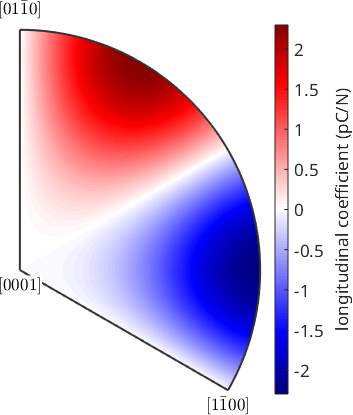
The sector contains both positive and negative response. Blue and red therefore mean opposite signs of the longitudinal component, not weak and strong polarization.
A rank three directional response is odd: \(q(-n)=-q(n)\). Plotting both hemispheres makes that sign reversal explicit.
close all;
plot(P,'complete','smooth','upper','lower');
mtexColorbar('title','longitudinal coefficient (pC/N)');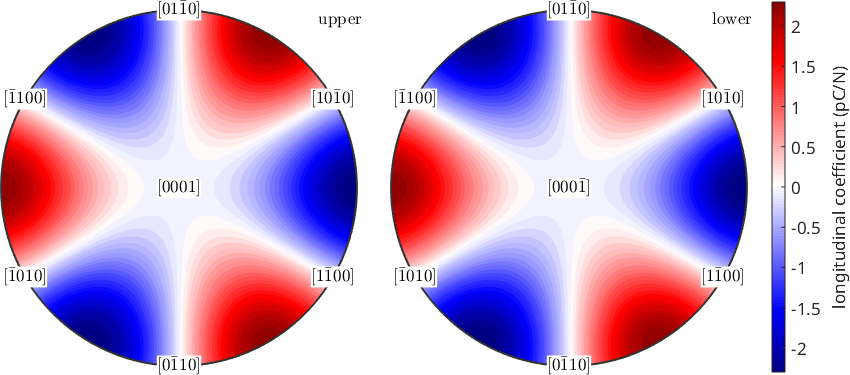
The same threefold pattern occurs on the two hemispheres with red and blue exchanged at antipodal directions. This is the sign reversal expected for an odd-rank tensor.
A radial surface
surf can use the absolute response as distance from the origin and the colour as its sign. The 'noScaling' option keeps the physical zero and the original pC/N values.
close all;
surf(q,'noScaling');
mtexColorbar('title','longitudinal coefficient (pC/N)');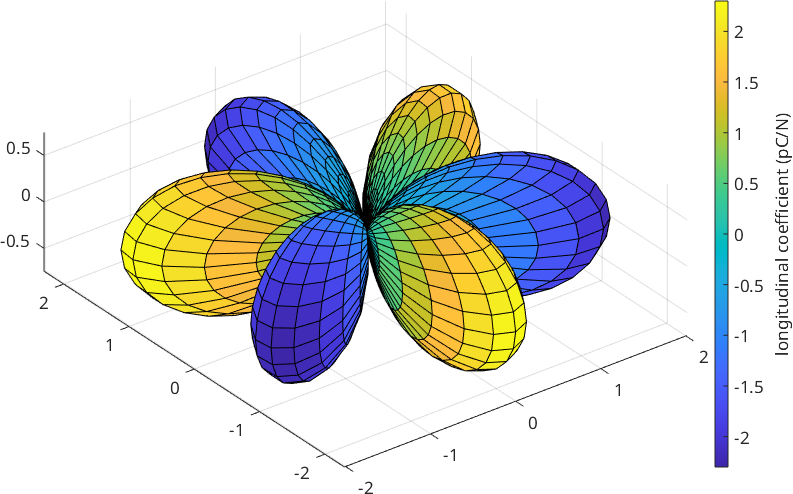
The six lobes have the same radial magnitude in antipodal pairs, while their colours have opposite signs. The surface meets the origin in directions where the longitudinal response is zero.
Planar sections
plotSection draws the signed response as a polar radius in a chosen plane. A negative radius is placed in the opposite direction, so each curve is traced twice. Use the coloured hemisphere plots above, rather than these outlines, to read the sign.
The basal plane is normal to z.
close all;
plotSection(q,vector3d.Z);
xlabel('x');
ylabel('y');
drawNow(gcm);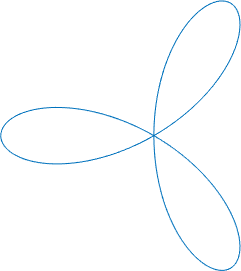
The basal section is a three-petal rose. Its threefold repetition is the clearest planar expression of quartz point group 32.
A vertical section normal to x has a different outline.
close all;
plotSection(q,vector3d.X);
ylabel('y');
zlabel('z');
drawNow(gcm);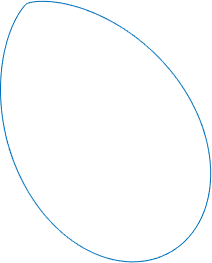
This section is a single oval rather than a three-petal rose because its plane contains the threefold z axis instead of cutting across it.
A polycrystal average needs handedness
The Tongue quartzite data contain one orientation for each of 382 grains. Mainprice, Lloyd, and Casey (1993) explain a decisive limitation of these measurements: routine electron-channelling patterns did not determine the handedness of each quartz grain. Every grain was indexed as right-handed. The paper therefore states that piezoelectricity cannot be calculated from this orientation set.
orientationFile = fullfile(mtexDataPath,'orientation',...
  'Tongue_Quartzite_Bunge_Euler');
ori = orientation.load(orientationFile,csQuartz,...
  'ColumnNames',{'Euler 1','Euler 2','Euler 3'});

orientationCount = length(ori)
orientationCount =
382The calculation below is still instructive as a counterexample. It uses calcTensor to rotate the right-handed tensor by every orientation and take their unweighted arithmetic mean. The result is an apparent aggregate in which all 382 grains have been assumed to be right-handed. It is not a prediction for the rock.
apparentMean = ori.calcTensor(P);
qApparent = apparentMean.directionalMagnitude;

close all;
plot(apparentMean,'complete','smooth','upper','lower');
mtexColorbar('title','apparent longitudinal coefficient (pC/N)');

responseRanges = array2table(...
  [min(q),max(q);min(qApparent),max(qApparent)],...
  'VariableNames',{'minimum','maximum'},...
  'RowNames',{'single crystal','all right-handed average'})
responseRanges =
2×2 table
minimum maximum
________ _______
single crystal -2.3 2.3
all right-handed average -0.59399 0.59399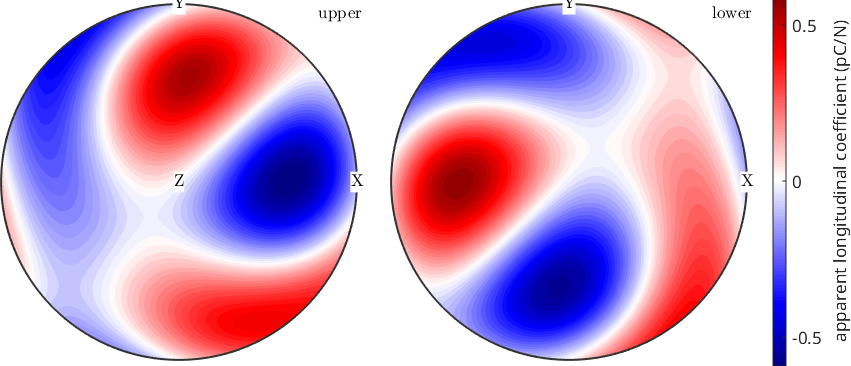
The single-crystal range is -2.3000 to 2.3000 pC/N. Under the deliberately false all-right-handed assumption, the range is -0.5940 to 0.5940 pC/N, or 25.8 percent of the single-crystal extreme.
Differently oriented grains partly cancel, which explains the reduction. Unknown left-handed grains can reverse additional contributions. Their number and orientations are absent from this data set, so the apparent average cannot be corrected without new handedness information.
Next
Birefringence continues with a rank two optical property, whose even rank makes its directional response antipodal. Tensor Averages develops Voigt, Reuss, and Hill estimates for elastic stiffness and explains their mechanical assumptions.
Further reading
- D. Mainprice, G.E. Lloyd, and M. Casey, Individual orientation measurements in quartz polycrystals: advantages and limitations for texture and petrophysical property determinations, Journal of Structural Geology 15 (1993), 1169-1187, documents the 382-grain data and its handedness limitation.
- IUCr Online Dictionary of Crystallography: Piezoelectricity lists the 20 piezoelectric point groups and relates the direct and converse tensors.
- IEEE Std 176-1987, IEEE Standard on Piezoelectricity, specifies quartz axes, signs, and contracted notation. The standard was withdrawn in 2000.
- J.F. Nye, Physical Properties of Crystals: Their Representation by Tensors and Matrices, Oxford University Press, 1985, develops tensor representation surfaces and crystal symmetry.
- C. Frondel, The System of Mineralogy, Volume III: Silica Minerals, 7th ed., Wiley, 1962, is the source named in the bundled quartz coefficient file.
setMTEXpref('defaultColorMap',WhiteJetColorMap);
Citing this page.
This page is part of the documentation of
MTEX, a free and open
source MATLAB toolbox for analyzing and modeling crystallographic textures.
It was written by The MTEX Developers and is published at
https://mtex-toolbox.github.io/PiezoElectricity.html.
If you use MTEX, or reuse text or figures from this page, in your research,
please cite
F. Bachmann, R. Hielscher, H. Schaeben: Texture Analysis with MTEX - Free and Open Source Software Toolbox, Solid State Phenomena 160 (2010), 63-68. 10.4028/www.scientific.net/SSP.160.63
BibTeX
@article{bachmann2010mtex,
  author  = {F. Bachmann and R. Hielscher and H. Schaeben},
  title   = {Texture Analysis with MTEX - Free and Open Source Software Toolbox},
  journal = {Solid State Phenomena},
  volume  = {160},
  pages   = {63-68},
  year    = {2010},
  doi     = {10.4028/www.scientific.net/SSP.160.63},
  url     = {https://doi.org/10.4028/www.scientific.net/SSP.160.63}
}
Other papers describing specific MTEX methods are listed under Publications — please cite the one that best fits your application. The MTEX source code is licensed under the GNU General Public License v2.0; the text and figures of this documentation are licensed under CC BY 4.0, which permits reuse — including by automated systems — provided The MTEX Developers and this page are credited.