
Axes alignment answers which reference-frame direction points north, east or out of the screen. MTEX uses the same plotting convention for an EBSD map and the pole figures derived from it, so the same specimen directions remain aligned across figures.
Changing a plotting convention changes only how data is drawn. It does not rotate the physical object or re-express it in another reference frame. Different conventions are useful when comparing crystal and specimen directions or viewing orthogonal two-dimensional EBSD sections.
plottingConvention.default('y↑→x');Reference Frames Carry the Alignment
A reference frame identifies where coordinates are expressed, supplies a basis and provides a default convention for drawing them. The point-group symmetry attached to a frame is a separate property. A plottingConvention describes the on-screen alignment, and the read-only how2plot property reports the convention that an object will use.
v1 = vector3d(1,1,1);
v2 = vector3d(-1,1,1);
v1.how2plot
ans = plottingConvention (y↑→x)The display states that y points north and x points east. Freshly created vectors are frame-free: their frame is empty, and their convention is resolved against specimenFrame.default when they are drawn. Pointing at the default frame instance would instead make them framed data.
A spherical plot outside crystal coordinates is annotated with the axis names of the session's default specimen frame. The labels therefore make the alignment visible in the figure.
plot(v1,'label','v_1','figSize','small')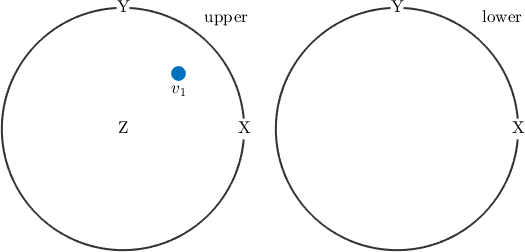
The labels show x to the east and y to the north. Changing the convention of the session frame changes frame-free and default-framed objects, including v1 and v2, and affects subsequent plots.
plottingConvention.default('y←↑x');
plot(v1,'label','v_1','figSize','small')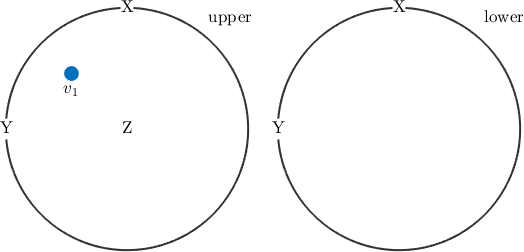
Now y points west and x points north, so the marker and annotations turn together. The commands plotx2east, plotx2north and plotzIntoPlane set common session conventions.
plottingConvention.default('y↑→x');One Plot in a Different Alignment
A single plot may be drawn in any convention by passing it as an option. The arrow string states the frame directly: in 'z↑→x', z points north and x points east. This override affects neither the data nor the session.
plot(v1,'how2plot','z↑→x','label','v_1')
nextAxis
plot(v2,'label','v_2')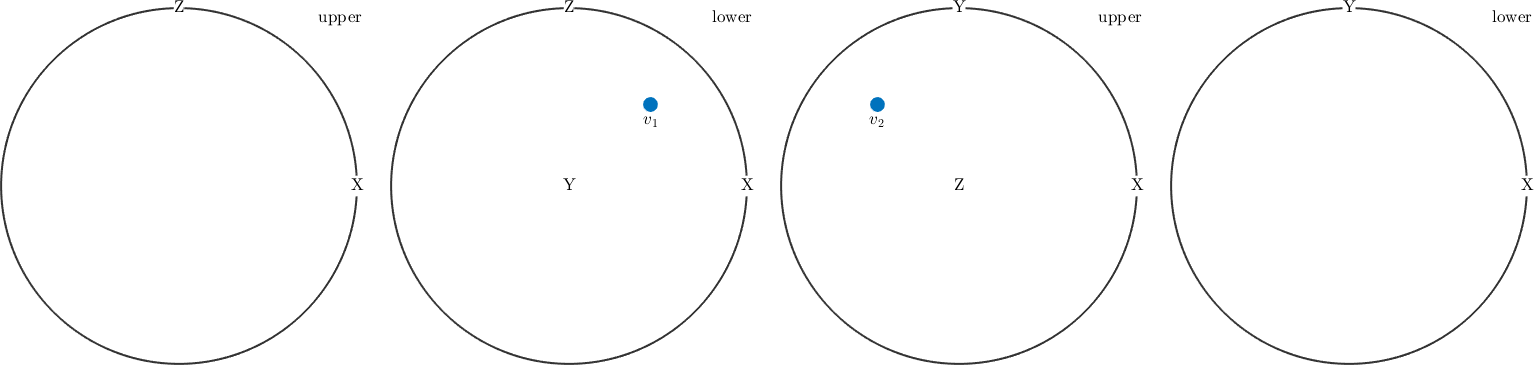
Each command draws an upper and a lower panel, so the figure holds four disks. The first pair uses the explicit z-north convention. Under it the out-of-screen direction is \(-y\), which puts \(v_1\) in the lower panel of that pair and leaves its upper panel empty. The second pair returns to the session convention, so the override is local to the plot that asked for it.
A convention may be passed as a plottingConvention or as the string that names it. A plotting convention belongs to a reference frame, never directly to a data object. There are three ways to choose an alignment:
- for one plot,
plot(v1,'how2plot','z↑→x')as above - for the session,
plottingConvention.default('z↑→x') - by associating data with a named frame that carries its own convention,
v1.frame = specimenFrame.rolling
Assigning a convention to the data itself, such as ebsd.how2plot = 'z↑→x', is not one of them. The how2plot property is read-only except on referenceFrame. The old assignment syntax attached a private copy of the session frame to one object. That copy looked like the session frame in displays but silently stopped following later changes.
Named Reference Frames
A specimen frame has an identity and named axes. The frame in which an Oxford instrument states Euler angles is specimenFrame.measurement with the axes X1, Y1 and Z1 in Oxford notation: the sample surface CS1. For rolled sheets the frame specimenFrame.rolling names its axes RD, TD and ND. Its typical rolling convention puts RD to the north and TD to the west.
specimenFrame.rollingans = specimenFrame (rolling, TD←RD↑)The object summary reports both the named axes and their convention. Any specimen frame can supply the session default. After
specimenFrame.rolling.makeDefaultframe-free data uses the rolling convention, and spherical plots annotate RD, TD and ND rather than X, Y and Z. No manual labels are required.
plot(v2,'upper','label','v_2')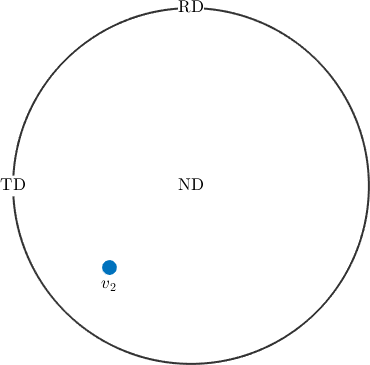
The annotations now name the rolling axes, while the vector coordinates themselves are unchanged. Return to the generic specimen frame for the rest of the page.
specimenFrame.specimen.makeDefault
plottingConvention.default('y↑→x');
The pfAnnotations preference stores the function that annotates spherical plots. By default it draws the named axes of the session frame. It can be replaced by a custom annotation or disabled for the session:
setMTEXpref('pfAnnotations',@(varargin) []);For one plot, 'noLabel' suppresses the frame annotation instead.
plot(v1,'upper','label','v_1','noLabel')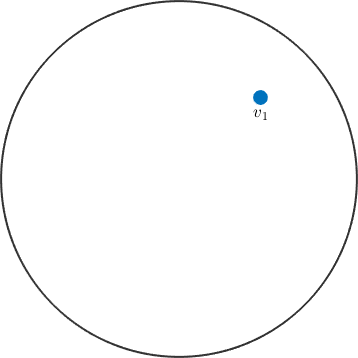
The vector label remains, but the reference-frame axis labels are absent.
Imported Data
An imported file does not decide how the rest of the session is drawn. No vendor gives the map a specimen-frame identity, so imported positions use the generic specimen frame with axes X, Y and Z. Associate an EBSD map with a named frame, for example ebsd.frame = specimenFrame.rolling, once its specimen directions are known. This labels the existing coordinates; it is not a frame change.
plottingConvention.default('y↑→x');
mtexdata dubna silent

pf.how2plot
plot(pf{1:4})
ans = plottingConvention (y↑→x)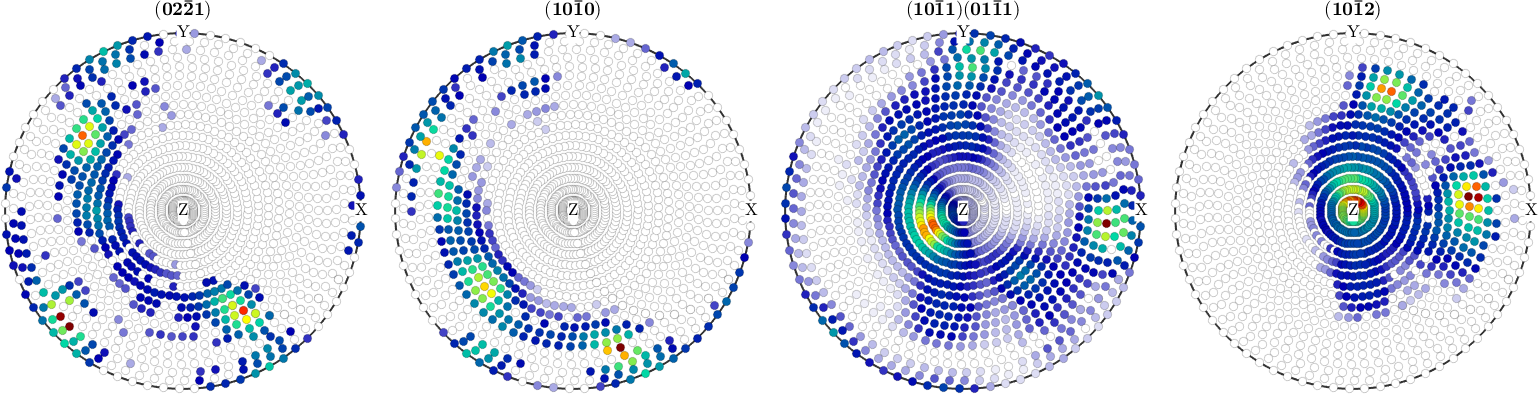
The printed convention and the axis annotations agree. The four pole figures use the same specimen alignment. Quantities derived from these data inherit that alignment.
odf = calcODF(pf,'silent');

plotPDF(odf,pf.allH{1:4})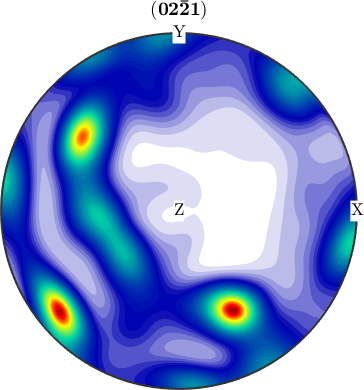
The reconstructed ODF produces pole figures with the same axis placement as the imported measurements, so corresponding peaks can be compared.
Crystal Frames
Data in crystal coordinates, such as Miller directions, uses the crystal frame attached to its symmetry. A crystal frame is the Cartesian reference frame fixed to the lattice basis. Its alignment follows the crystal axes and the frame options used when the symmetry was created, such as X parallel to a. The symmetry display states the resulting convention in crystal directions, for example ⊙c→a means c points out of the screen and a points east.
cs = crystalSymmetry('321','X||a')cs = crystalSymmetry (⊙c→a)
symmetry : 321
elements : 6
a, b, c : 1, 1, 1
reference frame: X||a, Y||b*, Z||cThe summary reports the crystal-frame alignment. A pole figure itself is not crystal-framed, although it is computed from crystal directions. An orientation maps coordinates from its right frame to its left frame, so ori * h lies in the left, specimen frame. The pole figure consequently uses the specimen convention.
The Reference-Frame Indicator on EBSD Maps
An EBSD or grain map shows its alignment inside the scale-bar box. The indicator uses the axis names of the map's reference frame. An axis with an in-plane component is drawn as an arrow. An axis along the viewing direction becomes a circled dot when it points out of the screen and a circled cross when it points into the screen.
mtexdata titanium silent

ipfKey = ipfColorKey(ebsd.orientations);
ipfColor = ipfKey.orientation2color(ebsd.orientations);

plot(ebsd,ipfColor,'how2plot','y↑→x','refFrame','on','figSize','small')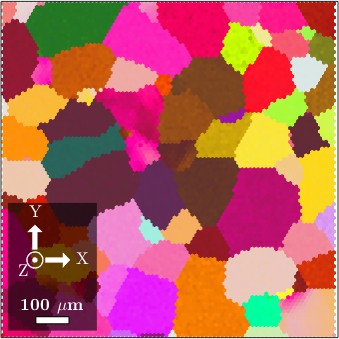
The indicator shows y north and x east, matching the explicit convention. Changing the plotting convention turns the indicator with the map.
figure
plot(ebsd,ipfColor,'how2plot','y←↑x','refFrame','on','figSize','small')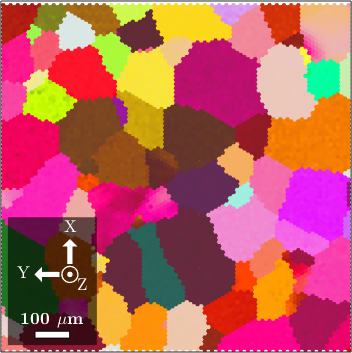
In the second map y points west and x points north. The colours remain attached to the same measurements while the map and indicator rotate. The indicator can be disabled for one plot with 'refFrame','off' or for the entire session with setMTEXpref('showRefFrame','off').
plot(ebsd,ipfColor,'how2plot','y↑→x','refFrame','off','figSize','small')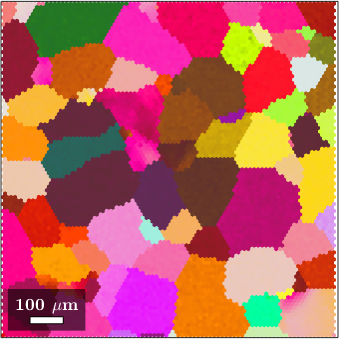
The final map keeps the first alignment but omits only the indicator.
Next
Once related figures share a reference-frame alignment, Combined Plots shows how to overlay them or arrange them in comparable panels.
Further reading
Britton et al., Crystal orientations and EBSD - or which way is up?, explains why explicit frame conventions are essential when EBSD data moves between software. ISO 24173:2024 gives the current international guidance for reproducible EBSD orientation measurements.
Citing this page.
This page is part of the documentation of
MTEX, a free and open
source MATLAB toolbox for analyzing and modeling crystallographic textures.
It was written by The MTEX Developers and is published at
https://mtex-toolbox.github.io/AxesAlignment.html.
If you use MTEX, or reuse text or figures from this page, in your research,
please cite
F. Bachmann, R. Hielscher, H. Schaeben: Texture Analysis with MTEX - Free and Open Source Software Toolbox, Solid State Phenomena 160 (2010), 63-68. 10.4028/www.scientific.net/SSP.160.63
BibTeX
@article{bachmann2010mtex,
  author  = {F. Bachmann and R. Hielscher and H. Schaeben},
  title   = {Texture Analysis with MTEX - Free and Open Source Software Toolbox},
  journal = {Solid State Phenomena},
  volume  = {160},
  pages   = {63-68},
  year    = {2010},
  doi     = {10.4028/www.scientific.net/SSP.160.63},
  url     = {https://doi.org/10.4028/www.scientific.net/SSP.160.63}
}
Other papers describing specific MTEX methods are listed under Publications — please cite the one that best fits your application. The MTEX source code is licensed under the GNU General Public License v2.0; the text and figures of this documentation are licensed under CC BY 4.0, which permits reuse — including by automated systems — provided The MTEX Developers and this page are credited.