
A twin law is a special crystallographic orientation relationship between parts of the same crystal species. Growth, transformation, and deformation twins arise by different processes. Each repeats one discrete lattice relationship.
MTEX represents the rotational part of a twin law as a same-phase misorientation. This page constructs an ideal twin law, explains why its quoted angle depends on crystal symmetry, and compares it with an EBSD map.
Start with Theory of Misorientations if symmetry-equivalent misorientations and disorientation are unfamiliar. The treatment of an unordered pair of same-phase grains is introduced in Grain Exchange Symmetry.
plottingConvention.default('y↑→x');
mtexdata twins silent

% use the crystal symmetry and lattice parameters stored with the data
CS = ebsd('Magnesium').CS;
Constructing an Ideal Twin Relationship
A rotation is fixed by two non-parallel correspondences. For the magnesium extension twin, choose a parent plane normal and direction. Their counterparts describe the same features in the twin.
parentPlane = Miller(1,-1,0,1,CS);
twinPlane = Miller(1,0,-1,-1,CS);
parentDirection = Miller(0,1,-1,1,CS,'uvw');
twinDirection = Miller(1,-1,0,1,CS,'uvw');

% map the parent correspondences onto the twin correspondences
twinning = orientation.map(parentPlane,twinPlane,...
  parentDirection,twinDirection);
round2Miller recovers one low-index description of the relationship. Crystal symmetry permits several equally valid descriptions. The reported indices therefore need not repeat the input representatives.
round2Miller(twinning)plane parallel direction parallel fit
(101̅1̅) || (011̅1) [011̅1] || [11̅01] 0°Seeing the Reorientation
The same hexagonal crystal shape can represent the parent and the twin. The twin law rotates the orange copy while leaving its lattice and shape unchanged.
cS = crystalShape.hex(CS);

close all;
plot(cS,'FaceColor','LightSkyBlue','FaceAlpha',0.55,'figSize','large');
hold on;
plot(0.9 * (twinning * cS),'FaceColor','orange','FaceAlpha',0.55);
hold off;
view(35,20);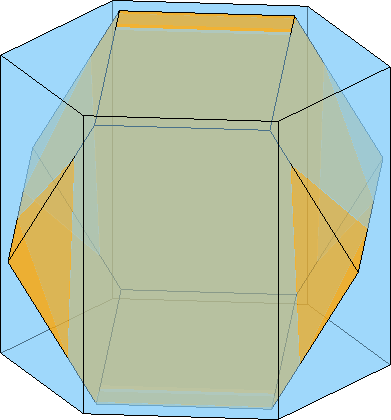
The two prisms have the same faces and proportions. Their discrete relative placement is the orientation relationship; the picture does not show the shear or the plane of their physical interface.
Why 86.3 Degrees and 180 Degrees Are Both Correct
A twin law is an equivalence class of rotations under crystal symmetry. angle returns the smallest-angle representative by default, while the max option returns the largest-angle representative.
twinAngles = [angle(twinning),angle(twinning,'max')] ./ degreetwinAngles =
86.2992 180.0000The magnesium extension twin therefore has a disorientation angle of \(86.299^\circ\), but the same twin law also has a \(180^\circ\) representative. A textbook using the 180 degree description and MTEX reporting 86.3 degrees are not in conflict.
The rotation axis changes with the representative as well. Always state which representative and crystal frame an axis belongs to. Axis Distribution develops this distinction for populations of misorientations.
Comparing the Twin Law with Measured Boundaries
A grain is a phase-homogeneous, spatially connected region of EBSD pixels produced by segmentation. The map is segmented at \(5^\circ\), and grains with fewer than five indexed pixels are excluded. Boundary geometry is then smoothed for five iterations before trace lengths are compared.
grains = calcGrains(ebsd,'angle',5*degree,'minPixel',5);
grains = smoothBoundary(grains,5);

% retain only boundaries between magnesium grains
gB = grains.boundary('Magnesium','Magnesium');
A same-phase boundary is unordered. Marking the ideal relationship as antipodal makes its inverse equivalent. This is the grain exchange symmetry required for the comparison.
twinBoundaryRelation = twinning;
twinBoundaryRelation.antipodal = true;

% compare the complete misorientation with the ideal relationship
twinDeviation = angle(gB.misorientation,twinBoundaryRelation) ./ degree;

close all;
histogram(twinDeviation,0:2:90);
xlabel('deviation from ideal twin (degree)');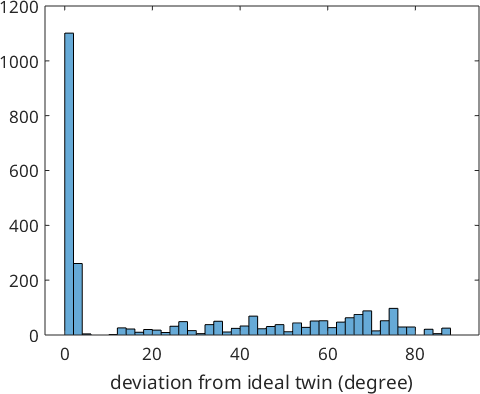
The strong concentration near zero is the repeated extension-twin relationship. Comparing only boundary angles near 86.3 degrees would discard the axis information and can admit unrelated boundaries.
Candidate Twin Boundaries
A five degree tolerance selects candidate boundaries in this example. The tolerance is an analyst choice, not a universal property of the twin law, and should reflect orientation uncertainty and the scientific aim.
isCandidate = twinDeviation < 5;

% weight the result by boundary trace length rather than segment count
candidateTracePercent = 100 * sum(gB(isCandidate).segLength) ...
  ./ sum(gB.segLength)
candidateTracePercent =
49.0249With this segmentation, smoothing, and tolerance, candidates account for about 49 percent of the magnesium-to-magnesium boundary trace length.
close all;
plot(grains,grains.meanOrientation,'ipfDirection',zvector,...
  'micronbar','off');
hold on;
plot(gB(isCandidate),'linecolor','w','linewidth',3);
hold off;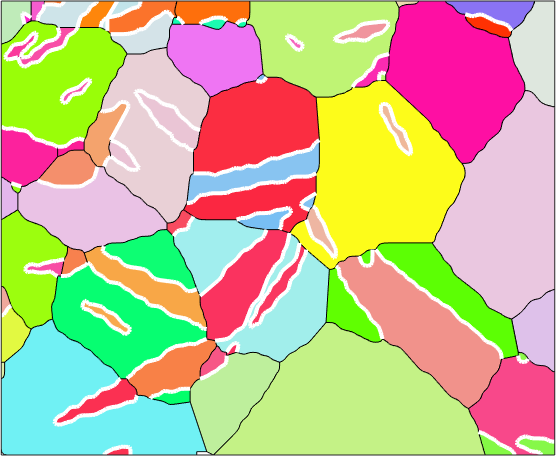
The white traces follow the thin lamellae in the orientation map. This spatial agreement supports the crystallographic classification.
A misorientation match alone does not prove a twinning mechanism. A full boundary description also needs the interface-plane orientation. A two-dimensional EBSD map measures only its trace. Morphology, loading, and other evidence may also be needed. Twinning Analysis infers a relationship from measured boundaries and inspects the selected traces.
References
- Th. Hahn and H. Klapper, Twinning of Crystals, International Tables for Crystallography, Vol. D, ch. 3.3, pp. 393--448, 2006. This chapter treats twin laws, morphology, origins, and interfaces.
- J. W. Christian and S. Mahajan, Deformation Twinning, Progress in Materials Science 39 (1995), 1--157. This review covers twinning shear, modes, and deformation mechanisms.
- Y. Zhang et al., A General Method to Determine Twinning Elements, Journal of Applied Crystallography 43 (2010), 1426--1430. This paper connects measured orientation relationships with classical twinning elements.
Next
A single ideal relationship appears as a peak in a population. Misorientation Distribution Function compares correlated boundary misorientations with the uncorrelated distribution expected from texture.
The same distinction reduced to rotation angle alone is developed in Angle Distribution. Twin laws between parent and product phases lead into Phase Transitions.
Citing this page.
This page is part of the documentation of
MTEX, a free and open
source MATLAB toolbox for analyzing and modeling crystallographic textures.
It was written by The MTEX Developers and is published at
https://mtex-toolbox.github.io/Twinning.html.
If you use MTEX, or reuse text or figures from this page, in your research,
please cite
F. Bachmann, R. Hielscher, H. Schaeben: Texture Analysis with MTEX - Free and Open Source Software Toolbox, Solid State Phenomena 160 (2010), 63-68. 10.4028/www.scientific.net/SSP.160.63
BibTeX
@article{bachmann2010mtex,
  author  = {F. Bachmann and R. Hielscher and H. Schaeben},
  title   = {Texture Analysis with MTEX - Free and Open Source Software Toolbox},
  journal = {Solid State Phenomena},
  volume  = {160},
  pages   = {63-68},
  year    = {2010},
  doi     = {10.4028/www.scientific.net/SSP.160.63},
  url     = {https://doi.org/10.4028/www.scientific.net/SSP.160.63}
}
Other papers describing specific MTEX methods are listed under Publications — please cite the one that best fits your application. The MTEX source code is licensed under the GNU General Public License v2.0; the text and figures of this documentation are licensed under CC BY 4.0, which permits reuse — including by automated systems — provided The MTEX Developers and this page are credited.