
A misorientation maps crystal coordinates of one crystal into those of another. For grains of the same phase, neither side of their shared boundary is intrinsically first. Swapping the grains replaces the misorientation by its inverse, but it does not describe a different boundary, and no measurement can tell the two apart.
This identification is grain exchange symmetry. It is a symmetry of an unordered pair of grains, not an additional symmetry of either crystal. MTEX records it in the antipodal property of a misorientation.
The name is shared with the flag that identifies opposite directions, described in Axes and Antipodal Symmetry. For a vector it means that \(\mathbf{v}\) and \(-\mathbf{v}\) are equivalent. For a misorientation it means that \(m\) and \(m^{-1}\) are equivalent.
plottingConvention.default('y↑→x');

cs = crystalSymmetry('622');
Without Grain Exchange Symmetry
Start with a \(40^\circ\) misorientation and compare it with its inverse. The antipodal property is initially false, so the order of the two crystals matters.
mori = orientation.byAxisAngle(Miller(1,2,-3,1,cs),40*degree,cs,cs);

angle(mori,inv(mori)) ./ degree
ans =
14.0873The two descriptions are about \(14.1^\circ\) apart after crystal symmetry has been applied. They are therefore distinct when MTEX treats the pair as ordered. That is the right answer between two different phases, where "first" and "second" mean something - the parent and the child of a transformation, say.
In axis--angle coordinates, inversion keeps the rotation angle and reverses the axis. The two markers below consequently occupy opposite points on the upper and lower hemispheres.
axMori = axis(mori,'noSymmetry');
axInverse = axis(inv(mori),'noSymmetry');

plot(axMori,'complete','MarkerSize',12,'DisplayName','m','grid','on')
hold on
plot(axInverse,'complete','MarkerSize',12,'DisplayName','inverse(m)')
hold off
legend('show','Location','southeast');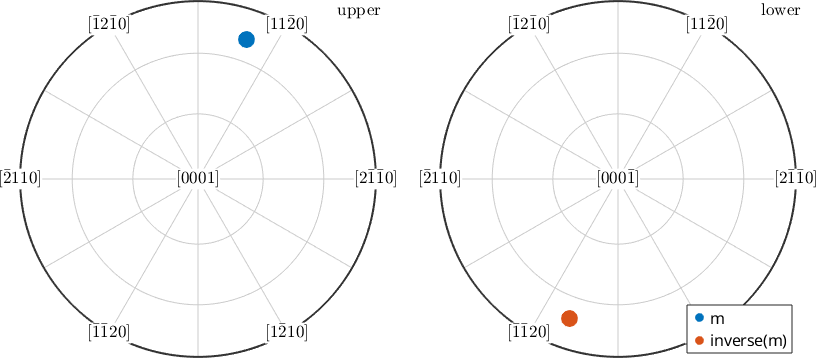
The blue and orange points are antipodal: they mark the same \(40^\circ\) angle about opposite axes. Grain exchange symmetry will identify this pair; it will not change the stored rotation.
Point group 622 has 12 proper rotations. Acting from both crystal frames gives \(12 \times 12 = 144\) symmetrically equivalent descriptions for this ordered pair.
numEquivalentOrdered = length(mori.symmetrise)numEquivalentOrdered =
144With Grain Exchange Symmetry
Set antipodal when the grain order is arbitrary.
mori.antipodal = true;

angle(mori,inv(mori)) ./ degree
ans =
0The symmetry-aware distance is now zero because the inverse belongs to the same equivalence class. This does not say that the misorientation is the identity; its rotation angle is still \(40^\circ\).
For this generic example, symmetrise now includes the inverse of every crystal-symmetry equivalent. The displayed list therefore doubles from 144 to 288 descriptions.
numEquivalentUnordered = length(mori.symmetrise)numEquivalentUnordered =
288The Fundamental Region Becomes Smaller
A fundamental region keeps one representative of each equivalence class. Adding grain exchange symmetry identifies each misorientation with its inverse, so fewer representatives are needed.
orderedRegion = fundamentalRegion(cs,cs);
exchangeRegion = fundamentalRegion(cs,cs,'antipodal');

plot(orderedRegion,'boundaryColor',[0.2 0.4 0.8],...
  'noSurface','figSize','small')
hold on
plot(exchangeRegion,'boundaryColor',[0.85 0.3 0.1],'noSurface')
hold off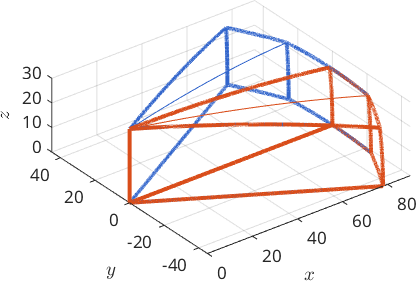
The blue outline is the region for an ordered pair. The orange outline is the region after inverse misorientations have been identified. It has half the volume, and here it lies inside the blue one. The number of faces is not a measure of region size.
Where MTEX Sets the Flag Automatically
A grain is a phase-homogeneous, spatially connected region of EBSD pixels produced by segmentation. See grain reconstruction for that step. Boundary misorientations between grains of one phase receive grain exchange symmetry automatically.
mtexdata twins silent

grains = calcGrains(ebsd,'threshold',5*degree,'minPixel',5);

grains.boundary('Mag','Mag').misorientation.antipodal
ans =
logical
1Between two phases, the phase labels distinguish the source and target crystal frames. Reversing a forsterite-to-enstatite mapping gives an enstatite-to-forsterite mapping, so MTEX leaves the flag off.
mtexdata forsterite silent

grains = calcGrains(ebsd);

grains.boundary('Fo','En').misorientation.antipodal
ans =
logical
0The same distinction applies inside one grain. A misorientation between the grain mean and an orientation measured within that grain has a fixed reference and target, so antipodal belongs off. See Grain Orientation Parameters for this grain-reference orientation deviation.
Why Swapping Gives the Inverse
Let \(g_1\) and \(g_2\) be orientations that map the two crystal frames into the specimen frame. The misorientation of the ordered pair maps crystal 2 coordinates into crystal 1,
\[m_{12} = g_1^{-1}g_2.\]
Swapping the grains reverses the composition:
\[m_{21} = g_2^{-1}g_1 = m_{12}^{-1}.\]
The algebra always gives the inverse. Grain exchange symmetry identifies the two results only when the grain pair is physically unordered and both grains have the same phase.
References
- A. Morawiec, Orientations and Rotations: Computations in Crystallographic Textures, Springer, 2004, develops rotation-space geometry and crystalline-interface symmetry.
- S. Patala and C. A. Schuh, Topology of Homophase Grain Boundaries in Two-Dimensional Crystals: The Role of Grain Exchange Symmetry, Computers, Materials & Continua 17 (2010), 1--18, develops the topological consequences of indistinguishable adjoining grains.
- R. Krakow et al., On Three-Dimensional Misorientation Spaces, Proceedings of the Royal Society A 473 (2017), 20170274, shows how grain exchange symmetry halves a same-phase misorientation fundamental zone.
Next
Continue with Twinning, where same-phase boundary misorientations are compared with an ideal orientation relationship. The geometric effect of the flag is developed further in Fundamental Region, and its effect on populations appears in Axis Distribution.
Citing this page.
This page is part of the documentation of
MTEX, a free and open
source MATLAB toolbox for analyzing and modeling crystallographic textures.
It was written by The MTEX Developers and is published at
https://mtex-toolbox.github.io/MisorientationGrainExchangeSym.html.
If you use MTEX, or reuse text or figures from this page, in your research,
please cite
F. Bachmann, R. Hielscher, H. Schaeben: Texture Analysis with MTEX - Free and Open Source Software Toolbox, Solid State Phenomena 160 (2010), 63-68. 10.4028/www.scientific.net/SSP.160.63
BibTeX
@article{bachmann2010mtex,
  author  = {F. Bachmann and R. Hielscher and H. Schaeben},
  title   = {Texture Analysis with MTEX - Free and Open Source Software Toolbox},
  journal = {Solid State Phenomena},
  volume  = {160},
  pages   = {63-68},
  year    = {2010},
  doi     = {10.4028/www.scientific.net/SSP.160.63},
  url     = {https://doi.org/10.4028/www.scientific.net/SSP.160.63}
}
Other papers describing specific MTEX methods are listed under Publications — please cite the one that best fits your application. The MTEX source code is licensed under the GNU General Public License v2.0; the text and figures of this documentation are licensed under CC BY 4.0, which permits reuse — including by automated systems — provided The MTEX Developers and this page are credited.