
converts orientations to rgb values by an inverse pole figure
The most common orientation coloring: a fixed specimen direction is rotated into the crystal frame and the resulting crystal direction is colored by a directionColorKey. Which key that is decides the flavour - ipfHSVKey, ipfTSLKey and ipfHKLKey differ in nothing else.
Syntax
oM = ipfColorKey(cs)
oM = ipfColorKey(ori)
oM = ipfColorKey(ebsd('phaseName'))
oM.ipfDirection = vector3d.Z;
rgb = oM.orientation2color(ori)
Input
| cs | crystalSymmetry |
| ori | orientation |
| ebsd | EBSD |
Output
| oM | ipfColorKey |
| rgb | list of RGB triplets |
Class Properties
| ipfDirection | the specimen direction the inverse pole figure is taken of |
| dirMap | the directionColorKey doing the coloring |
| CS1, CS2 | the two symmetry |
Example
mtexdata titanium
oM = ipfColorKey(ebsd);
plot(ebsd,oM.orientation2color(ebsd.orientations))
ebsd = EBSDhex (y↓→x)
Phase Orientations Mineral Color Symmetry Crystal reference frame
0 8100 (99%) Titanium (Alpha) LightSkyBlue 622 X||a, Y||b*, Z||c
Properties: ci, grainid, iq, sem_signal, oldId
Scan unit : um
X × Y × Z : [0 → 996] × [0 → 998] × [0 → 0]
Normal vector: (0,0,1)
Hex grid :97 × 84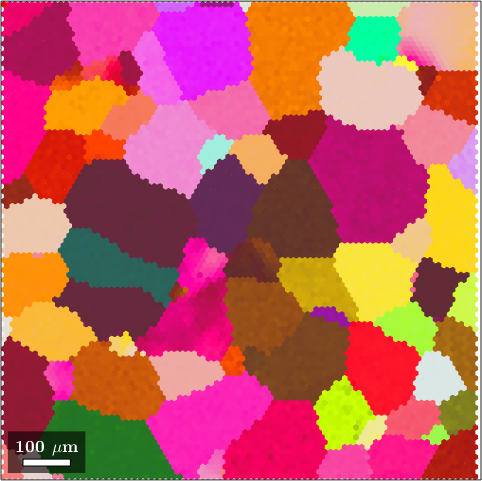
See also
Citing this page.
This page is part of the documentation of
MTEX, a free and open
source MATLAB toolbox for analyzing and modeling crystallographic textures.
It was written by The MTEX Developers and is published at
https://mtex-toolbox.github.io/ipfColorKey.html.
If you use MTEX, or reuse text or figures from this page, in your research,
please cite
F. Bachmann, R. Hielscher, H. Schaeben: Texture Analysis with MTEX - Free and Open Source Software Toolbox, Solid State Phenomena 160 (2010), 63-68. 10.4028/www.scientific.net/SSP.160.63
BibTeX
@article{bachmann2010mtex,
  author  = {F. Bachmann and R. Hielscher and H. Schaeben},
  title   = {Texture Analysis with MTEX - Free and Open Source Software Toolbox},
  journal = {Solid State Phenomena},
  volume  = {160},
  pages   = {63-68},
  year    = {2010},
  doi     = {10.4028/www.scientific.net/SSP.160.63},
  url     = {https://doi.org/10.4028/www.scientific.net/SSP.160.63}
}
Other papers describing specific MTEX methods are listed under Publications — please cite the one that best fits your application. The MTEX source code is licensed under the GNU General Public License v2.0; the text and figures of this documentation are licensed under CC BY 4.0, which permits reuse — including by automated systems — provided The MTEX Developers and this page are credited.