seperate directions into clusters
Syntax
[cId,center] = calcCluster(vec,'halfwidth',2.5*degree)
[cId,center] = calcCluster(vec,'numCluster',n,'method','hierarchical')
[cId,center] = calcCluster(vec,'maxAngle',omega,'method','hierarchical')
Input
| vec | vector3d |
| n | number of clusters |
| omega | maximum angle |
Output
| cId | list of clusters ids |
| center | center of the clusters |
Options
| method | classix (default) | hierarchical | matlab |
Example
%generate vector data of up to 5 clusters
plottingConvention.default('y↑→x');
vin = vector3d.rand(5);
sF2 = calcDensity(vin,'halfwidth',10*degree);
v   = sF2.discreteSample(800);
find clusters and their centers
[cId,center] = calcCluster(v,'numCluster',5,'method','hierarchical');visualize the result
plot(v,cId)
hold on
plot(center,'add2all','MarkerSize',10,'MarkerFaceColor','k')
hold off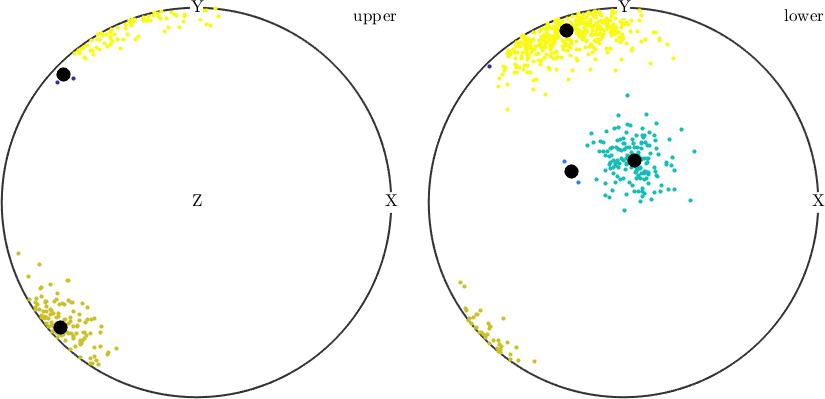
%check the accuracy of the recomputed centers
min(angle_outer(center,vin)./degree)
ans =
10.4473 0.7218 0.3485 0.6109 12.2760
Citing this page.
This page is part of the documentation of
MTEX, a free and open
source MATLAB toolbox for analyzing and modeling crystallographic textures.
It was written by The MTEX Developers and is published at
https://mtex-toolbox.github.io/vector3d.calcCluster.html.
If you use MTEX, or reuse text or figures from this page, in your research,
please cite
F. Bachmann, R. Hielscher, H. Schaeben: Texture Analysis with MTEX - Free and Open Source Software Toolbox, Solid State Phenomena 160 (2010), 63-68. 10.4028/www.scientific.net/SSP.160.63
BibTeX
@article{bachmann2010mtex,
  author  = {F. Bachmann and R. Hielscher and H. Schaeben},
  title   = {Texture Analysis with MTEX - Free and Open Source Software Toolbox},
  journal = {Solid State Phenomena},
  volume  = {160},
  pages   = {63-68},
  year    = {2010},
  doi     = {10.4028/www.scientific.net/SSP.160.63},
  url     = {https://doi.org/10.4028/www.scientific.net/SSP.160.63}
}
Other papers describing specific MTEX methods are listed under Publications — please cite the one that best fits your application. The MTEX source code is licensed under the GNU General Public License v2.0; the text and figures of this documentation are licensed under CC BY 4.0, which permits reuse — including by automated systems — provided The MTEX Developers and this page are credited.