
draw rotations connected by lines
Syntax
line(rot,'linecolor','r','linewith',2)Input
| rot | list of rotation |
Example
cs1 = crystalSymmetry('321')
cs2 = crystalSymmetry('432')
oR = fundamentalRegion(cs1,cs2)
plot(oR)
cs1 = crystalSymmetry (⊙c→a)
symmetry : 321
elements : 6
a, b, c : 1, 1, 1
reference frame: X||a*, Y||b, Z||c
cs2 = crystalSymmetry (⊙c→a)
symmetry: 432
elements: 24
a, b, c : 1, 1, 1
oR = orientationRegion
crystal symmetry: 321, X||a*, Y||b, Z||c
crystal symmetry: 432
max angle: 56.6003°
face normales: 14
vertices: 20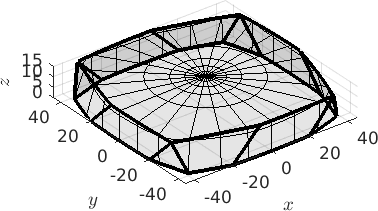
connect to vertices of the fundamental region
f = fibre(oR.V(1),oR.V(2))f = fibre (321 → 432)
h || r: (3̅ 11 8̅ 4) || ((0 11 4̅))
o1 → o2: (112̅0) || (110) [0001] || [1̅11] → (0001) || (111) [011̅0] || [011̅]determine some orientations along the fibre
o = f.orientationo = misorientation (321 → 432)
size: 2000 x 1plot the line
hold on
line(o,'color','r','linewidth',2)
hold off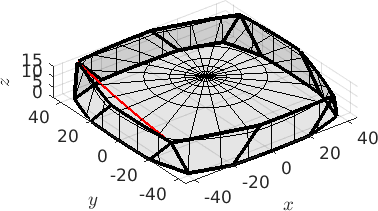
See also
Citing this page.
This page is part of the documentation of
MTEX, a free and open
source MATLAB toolbox for analyzing and modeling crystallographic textures.
It was written by The MTEX Developers and is published at
https://mtex-toolbox.github.io/rotation.line.html.
If you use MTEX, or reuse text or figures from this page, in your research,
please cite
F. Bachmann, R. Hielscher, H. Schaeben: Texture Analysis with MTEX - Free and Open Source Software Toolbox, Solid State Phenomena 160 (2010), 63-68. 10.4028/www.scientific.net/SSP.160.63
BibTeX
@article{bachmann2010mtex,
  author  = {F. Bachmann and R. Hielscher and H. Schaeben},
  title   = {Texture Analysis with MTEX - Free and Open Source Software Toolbox},
  journal = {Solid State Phenomena},
  volume  = {160},
  pages   = {63-68},
  year    = {2010},
  doi     = {10.4028/www.scientific.net/SSP.160.63},
  url     = {https://doi.org/10.4028/www.scientific.net/SSP.160.63}
}
Other papers describing specific MTEX methods are listed under Publications — please cite the one that best fits your application. The MTEX source code is licensed under the GNU General Public License v2.0; the text and figures of this documentation are licensed under CC BY 4.0, which permits reuse — including by automated systems — provided The MTEX Developers and this page are credited.