
sigma sections for ODF and orientation plotting
The MTEX default for plotting an ODF. Sigma sections are the pole figure of the c* axis, split up by sigma = phi1 - phi2. Unlike Euler angle sections they distort orientation space only mildly, so a component keeps its shape across the sections.
Syntax
oS = sigmaSections(cs1,cs2)
oS = sigmaSections(cs1,cs2,'sections',5)
oS = sigmaSections(cs1,cs2,'sigma',(0:15:90)*degree)
Input
| cs1, cs2 | crystalSymmetry, specimenSymmetry |
Options
| sections | number of sections |
| sigma | explicit section values |
| tolerance | largest deviation in sigma of an orientation drawn in a section (default 5°) |
Class Properties
| omega | the sigma value of each section |
| h1, h2 | the Miller the sections are built from |
| sR | sphericalRegion each section is plotted on |
| referenceField | S2VectorField sigma is measured against |
Example
mtexdata dubna
odf = calcODF(pf,'silent');
plotSection(odf,sigmaSections(odf.CS,odf.SS))
pf = PoleFigure (Quartz → y↓→x)
crystal symmetry : Quartz (321, X||a*, Y||b, Z||c)
h = (022̅1), r = 72 × 19 points
h = (101̅0), r = 72 × 19 points
h = (101̅1)(011̅1), r = 72 × 19 points
h = (101̅2), r = 72 × 19 points
h = (112̅0), r = 72 × 19 points
h = (112̅1), r = 72 × 19 points
h = (112̅2), r = 72 × 19 points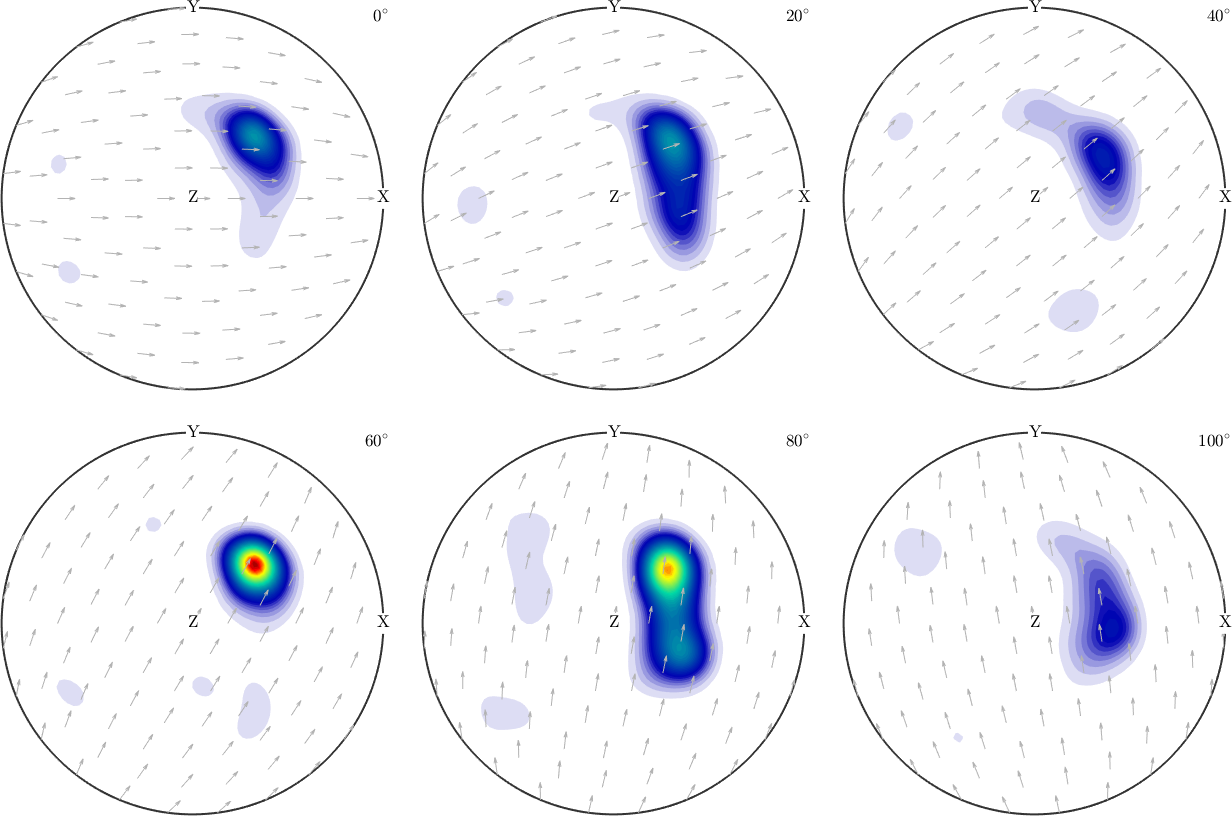
See also
Citing this page.
This page is part of the documentation of
MTEX, a free and open
source MATLAB toolbox for analyzing and modeling crystallographic textures.
It was written by The MTEX Developers and is published at
https://mtex-toolbox.github.io/sigmaSections.html.
If you use MTEX, or reuse text or figures from this page, in your research,
please cite
F. Bachmann, R. Hielscher, H. Schaeben: Texture Analysis with MTEX - Free and Open Source Software Toolbox, Solid State Phenomena 160 (2010), 63-68. 10.4028/www.scientific.net/SSP.160.63
BibTeX
@article{bachmann2010mtex,
  author  = {F. Bachmann and R. Hielscher and H. Schaeben},
  title   = {Texture Analysis with MTEX - Free and Open Source Software Toolbox},
  journal = {Solid State Phenomena},
  volume  = {160},
  pages   = {63-68},
  year    = {2010},
  doi     = {10.4028/www.scientific.net/SSP.160.63},
  url     = {https://doi.org/10.4028/www.scientific.net/SSP.160.63}
}
Other papers describing specific MTEX methods are listed under Publications — please cite the one that best fits your application. The MTEX source code is licensed under the GNU General Public License v2.0; the text and figures of this documentation are licensed under CC BY 4.0, which permits reuse — including by automated systems — provided The MTEX Developers and this page are credited.