
A material property is anisotropic when its response depends on direction. Heat conduction, elastic stiffness, and refractive index are often anisotropic in a crystal, while temperature and density are scalars.
A tensor relates physical quantities whose components may carry directions. Its rank is the number of indices needed to name one component. In three dimensions, a rank \(r\) tensor has \(3^r\) components before physical and crystal symmetries are applied. An isotropic property may still be a tensor; isotropy constrains its components rather than changing its rank.
Stress and strain are rank two tensors. The elastic stiffness that relates them has rank four and therefore starts with \(3^4=81\) components. Read Vectors first if components and bases are new.
The example below uses the room-pressure stiffness of San Carlos olivine measured by Abramson et al. (1997). It plots the Young's modulus of a rod cut along every crystal direction.
plottingConvention.default('y↑→x');

cs = crystalSymmetry('mmm',[4.7646 10.2296 5.9942],...
  'mineral','Olivine');
C = stiffnessTensor.load(...
  fullfile(mtexDataPath,'tensor','Olivine1997PC.GPa'),cs);

E = C.YoungsModulus;
plot(E,'complete','upper');
mtexColorbar('title','Young''s modulus in GPa');

youngsModulusRange = [min(E),max(E)]
youngsModulusRange =
164.5702 286.9259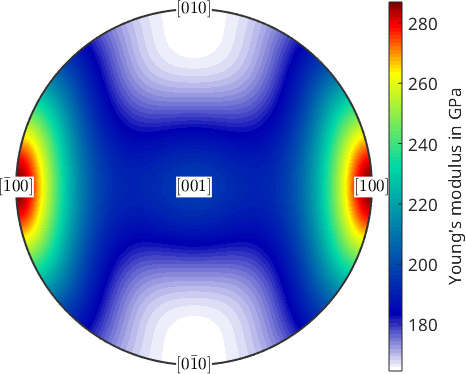
The printed range is 164.6 to 286.9 GPa. In the plot, the red lobes at [100] are the stiffest directions. The pale lobes near [010] are the softest, despite their light colour.
Neumann's principle requires every symmetry operation of the crystal point group to be a symmetry operation of the physical property. The repeated pattern here reflects the three perpendicular mirror planes of orthorhombic olivine. Stress symmetry, strain symmetry, and elastic energy first reduce the 81 stiffness components to at most 21 independent coefficients. Crystal symmetry reduces these further to nine for an orthorhombic crystal and three for a cubic crystal.
A tensor is meaningful only with its frame
A reference frame is the coordinate system in which data are expressed. It is distinct from the symmetry attached to that frame and from the plotting convention that lays the frame out on screen. The components of C above are expressed in its attached crystal frame.
An active rotation moves a physical property relative to the specimen. A frame change instead re-expresses the same physical object in a different reference frame and leaves the object itself untouched. MTEX provides rotate for the first operation and transformReferenceFrame for the second.
This distinction is especially important for low-symmetry crystals. Two sources may use different Cartesian alignments for the same lattice and publish different component tables for the same property. Crystal Reference System develops this choice. Units and compact-matrix conventions must also accompany imported values; Tensor Import shows how to audit them.
From one crystal to a polycrystal
A specimen contains crystals in different orientations. An orientation distribution function (ODF) describes their texture as a continuous material-volume density over crystal orientations. MTEX uses those orientations to express each single-crystal tensor in the specimen frame before averaging.
The effective response also depends on how stress and strain are shared. The Voigt estimate assumes uniform strain and averages stiffnesses. The Reuss estimate assumes uniform stress and averages compliances before inverting the result. Under linear elasticity they give upper and lower energy bounds, while the Hill estimate is their arithmetic mean.
These estimates do not determine the exact response of a real aggregate. Their separation can reflect single-crystal anisotropy, phase stiffness contrast, and phase proportions. Grain shape, spatial arrangement, porosity, and grain-boundary mechanics are absent from both estimates. Tensor Averages develops the assumptions and equations.
Where to start
Definition introduces tensor rank, component symmetries, typed tensor classes, and crystal frames. Import reads published coefficients together with their unit, frame, and compact-matrix convention.
Arithmetics separates active rotation from a frame change and develops the contractions that apply a tensor. Plotting develops directional functions and specialized tensor plots. Averages combines crystal properties with orientations or an ODF.
The worked Piezoelectricity page uses a rank three quartz tensor labelled in pC/N. Birefringence uses a rank two refractive-index tensor. Magnetic Anisotropy instead evaluates a quartic anisotropy law directly and does not instantiate a tensor.
Next
Elasticity continues from stiffness to moduli and wave speeds. Plasticity covers deformation past the elastic limit. the ODF tutorial constructs the orientation distribution used for aggregate averages. The crystal frames tensors use are introduced in Crystal Geometry.
Further reading
- R.E. Newnham, Properties of Materials: Anisotropy, Symmetry, Structure, Oxford University Press, 2005, connects tensor rank, symmetry, and crystal properties.
- A. Authier, editor, International Tables for Crystallography, Volume D: Physical Properties of Crystals, 2nd ed., IUCr, 2014, develops symmetry constraints on physical tensors.
- D. Mainprice, R. Hielscher, and H. Schaeben, Calculating anisotropic physical properties from texture data using the MTEX open-source package, Geological Society, London, Special Publications 360 (2011), 175-192.
- R. Hill, The Elastic Behaviour of a Crystalline Aggregate, Proceedings of the Physical Society A 65 (1952), 349-354, establishes the Voigt and Reuss bounds and discusses their mean.
- ISO 80000-2:2019, Quantities and units - Part 2: Mathematics, specifies mathematical tensor notation.
Citing this page.
This page is part of the documentation of
MTEX, a free and open
source MATLAB toolbox for analyzing and modeling crystallographic textures.
It was written by The MTEX Developers and is published at
https://mtex-toolbox.github.io/Tensors.html.
If you use MTEX, or reuse text or figures from this page, in your research,
please cite
F. Bachmann, R. Hielscher, H. Schaeben: Texture Analysis with MTEX - Free and Open Source Software Toolbox, Solid State Phenomena 160 (2010), 63-68. 10.4028/www.scientific.net/SSP.160.63
BibTeX
@article{bachmann2010mtex,
  author  = {F. Bachmann and R. Hielscher and H. Schaeben},
  title   = {Texture Analysis with MTEX - Free and Open Source Software Toolbox},
  journal = {Solid State Phenomena},
  volume  = {160},
  pages   = {63-68},
  year    = {2010},
  doi     = {10.4028/www.scientific.net/SSP.160.63},
  url     = {https://doi.org/10.4028/www.scientific.net/SSP.160.63}
}
Other papers describing specific MTEX methods are listed under Publications — please cite the one that best fits your application. The MTEX source code is licensed under the GNU General Public License v2.0; the text and figures of this documentation are licensed under CC BY 4.0, which permits reuse — including by automated systems — provided The MTEX Developers and this page are credited.