
A method of slipSystem.
the slip system <01-1>{111} of a face-centred cubic crystal
Syntax
sS = slipSystem.fcc(cs)
With the critical resolved shear stress 1.
sS = slipSystem.fcc(cs, CRSS=2)
With another.
Description
One system of the family; symmetrise gives every equivalent one.
Input
CS |
crystalFrame of a cubic crystal |
Keywords
| keyword | default | description |
|---|---|---|
CRSS |
1 |
the critical resolved shear stress |
Output
sS |
slipSystem |
Example
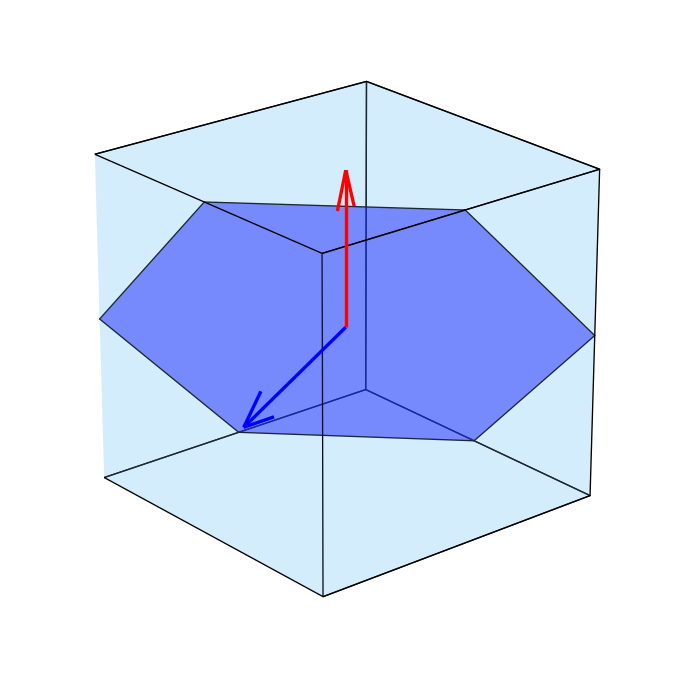
Construct an FCC slip family and compare its Schmid factors under crystal-axis tension. In the drawing, the blue plane and arrow are one slip system and the red arrow is the loading direction.
import numpy as np
import matplotlib.pyplot as plt
from mtex import crystalFrame, slipSystem, Miller, crystalShape, plot, hold, plotInnerDirection

cs = crystalFrame('m-3m')
representative = slipSystem.fcc(cs)
systems = representative.symmetrise(antipodal=True)
loading = Miller(0, 0, 1, cs, 'uvw')
factors = systems.SchmidFactor(loading)
print('Number of FCC systems:', systems.size)
print('Largest absolute Schmid factor:', round(float(np.max(np.abs(factors))), 4))
cube = crystalShape.cube(cs)
plot(cube, faceAlpha=0.2)
hold(True)
plot(cube, representative, faceColor='blue')
plotInnerDirection(cube, loading, faceColor='red')
hold(False)
plt.show()
All directions here are in crystal coordinates. For a specimen loading direction, rotate the systems into the specimen frame or transform the loading direction into the crystal frame first.
Number of FCC systems: 12
Largest absolute Schmid factor: 0.4082
See also
slipSystem, slipSystem.symmetrise, dislocationSystem
source
Citing this page.
This page is part of the documentation of
MTEX, a free and open
source MATLAB toolbox for analyzing and modeling crystallographic textures.
It was written by The MTEX Developers and is published at
https://mtex-toolbox.github.io/slipSystem.fcc_py.html.
If you use MTEX, or reuse text or figures from this page, in your research,
please cite
F. Bachmann, R. Hielscher, H. Schaeben: Texture Analysis with MTEX - Free and Open Source Software Toolbox, Solid State Phenomena 160 (2010), 63-68. 10.4028/www.scientific.net/SSP.160.63
BibTeX
@article{bachmann2010mtex,
  author  = {F. Bachmann and R. Hielscher and H. Schaeben},
  title   = {Texture Analysis with MTEX - Free and Open Source Software Toolbox},
  journal = {Solid State Phenomena},
  volume  = {160},
  pages   = {63-68},
  year    = {2010},
  doi     = {10.4028/www.scientific.net/SSP.160.63},
  url     = {https://doi.org/10.4028/www.scientific.net/SSP.160.63}
}
Other papers describing specific MTEX methods are listed under Publications — please cite the one that best fits your application. The MTEX source code is licensed under the GNU General Public License v2.0; the text and figures of this documentation are licensed under CC BY 4.0, which permits reuse — including by automated systems — provided The MTEX Developers and this page are credited.