
A property of plottingConvention.
the session default is the convention of the default specimen frame, so that everything holding that frame follows a change of it; plottingConvention.default(‘y↑→x’) sets it, plottingConvention.default(north=xvector) changes one direction and keeps the others (MATLAB’s plotx2east, plotx2north, plotx2west, plotx2south, plotzOutOfPlane and plotzIntoPlane)
Example
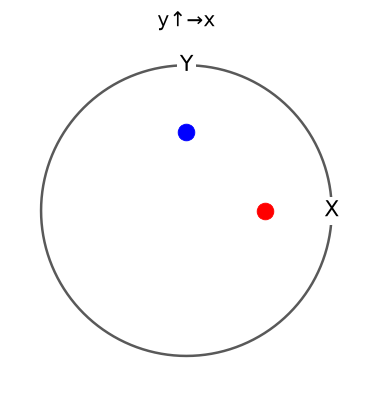
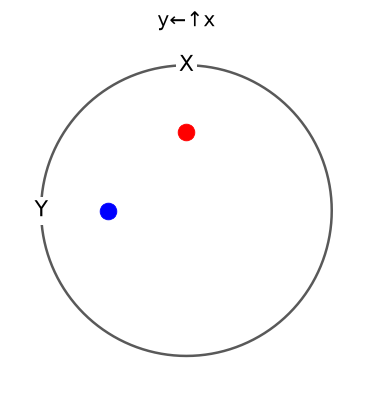
Display the same two specimen directions under two screen conventions. Red has positive X and Z components; blue has positive Y and Z components. Restore the session convention afterward.
import matplotlib.pyplot as plt
from mtex import plottingConvention, vector3d, plot, hold, mtexTitle

previous = plottingConvention(plottingConvention.default)
try:
    for convention in ('y↑→x', 'y←↑x'):
        plottingConvention.default(convention)
        plot(vector3d(1, 0, 1), upper=True, markerFaceColor='red', markerSize=10)
        hold(True)
        plot(vector3d(0, 1, 1), upper=True, markerFaceColor='blue', markerSize=10)
        hold(False)
        mtexTitle(convention)
finally:
    previous.makeDefault()
plt.show()
The data and physical reference frame stay the same; the convention determines their placement on screen. These changes are for this session and are not saved as user preferences.
Citing this page.
This page is part of the documentation of
MTEX, a free and open
source MATLAB toolbox for analyzing and modeling crystallographic textures.
It was written by The MTEX Developers and is published at
https://mtex-toolbox.github.io/plottingConvention.default_py.html.
If you use MTEX, or reuse text or figures from this page, in your research,
please cite
F. Bachmann, R. Hielscher, H. Schaeben: Texture Analysis with MTEX - Free and Open Source Software Toolbox, Solid State Phenomena 160 (2010), 63-68. 10.4028/www.scientific.net/SSP.160.63
BibTeX
@article{bachmann2010mtex,
  author  = {F. Bachmann and R. Hielscher and H. Schaeben},
  title   = {Texture Analysis with MTEX - Free and Open Source Software Toolbox},
  journal = {Solid State Phenomena},
  volume  = {160},
  pages   = {63-68},
  year    = {2010},
  doi     = {10.4028/www.scientific.net/SSP.160.63},
  url     = {https://doi.org/10.4028/www.scientific.net/SSP.160.63}
}
Other papers describing specific MTEX methods are listed under Publications — please cite the one that best fits your application. The MTEX source code is licensed under the GNU General Public License v2.0; the text and figures of this documentation are licensed under CC BY 4.0, which permits reuse — including by automated systems — provided The MTEX Developers and this page are credited.