
plotSection(odf), plotSection(odf, ‘sigma’), plotSection(ori, oS, sections=9)
Syntax
plot(x, *args, **kw)
Description
An SO3Fun or a list of orientations sliced into sections. Without a section object the default is the phi2 sections against a specimen frame and the axis angle sections between two crystals, as in MTEX; a string picks another family (‘phi1’, ‘phi2’, ‘alpha’, ‘gamma’, ‘sigma’, ‘pf’, ‘axisAngle’) and the keywords of the family name its sections.
Example
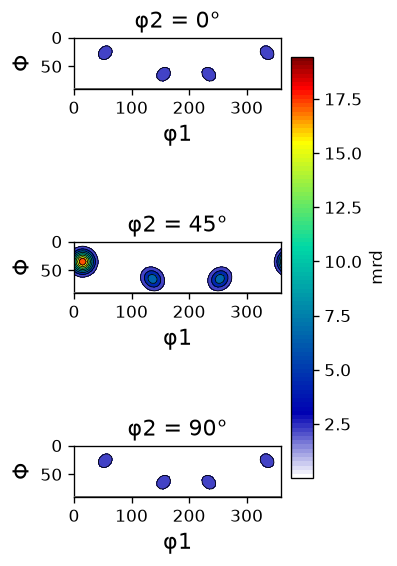
Plot a model ODF in three specified Bunge phi2 sections. The remaining two Euler angles vary within each panel; intensities are in multiples of a random distribution.
import numpy as np
import matplotlib.pyplot as plt
from mtex import crystalFrame, orientation, degree, unimodalODF, plotSection, mtexColorbar

cs = crystalFrame('m-3m')
centre = orientation.byEuler(15*degree, 35*degree, 45*degree, cs)
odf = unimodalODF(centre, halfwidth=15*degree)
plotSection(odf, 'phi2', np.array([0, 45, 90])*degree, resolution=5*degree, contourf=True)
mtexColorbar(title='mrd')
plt.show()
A section is a slice of the ODF. A pole figure is a projection of it; use plotPF for that view.
MATLAB’s SO3FunHarmonic.plot
source
Citing this page.
This page is part of the documentation of
MTEX, a free and open
source MATLAB toolbox for analyzing and modeling crystallographic textures.
It was written by The MTEX Developers and is published at
https://mtex-toolbox.github.io/SO3FunHarmonic.plot_py.html.
If you use MTEX, or reuse text or figures from this page, in your research,
please cite
F. Bachmann, R. Hielscher, H. Schaeben: Texture Analysis with MTEX - Free and Open Source Software Toolbox, Solid State Phenomena 160 (2010), 63-68. 10.4028/www.scientific.net/SSP.160.63
BibTeX
@article{bachmann2010mtex,
  author  = {F. Bachmann and R. Hielscher and H. Schaeben},
  title   = {Texture Analysis with MTEX - Free and Open Source Software Toolbox},
  journal = {Solid State Phenomena},
  volume  = {160},
  pages   = {63-68},
  year    = {2010},
  doi     = {10.4028/www.scientific.net/SSP.160.63},
  url     = {https://doi.org/10.4028/www.scientific.net/SSP.160.63}
}
Other papers describing specific MTEX methods are listed under Publications — please cite the one that best fits your application. The MTEX source code is licensed under the GNU General Public License v2.0; the text and figures of this documentation are licensed under CC BY 4.0, which permits reuse — including by automated systems — provided The MTEX Developers and this page are credited.