
measure the mean misorientation angle from each map measurement to its neighbours.
Syntax
omega = KAM(ebsd)
Description
For an MTEX object, KAM(x, …) calls x.KAM(…). Additional positional and keyword arguments are passed to that method unchanged. Its documentation specifies the accepted inputs, units, symmetry handling and optional outputs. Consult the corresponding method for the behaviour of a particular object type.
Example
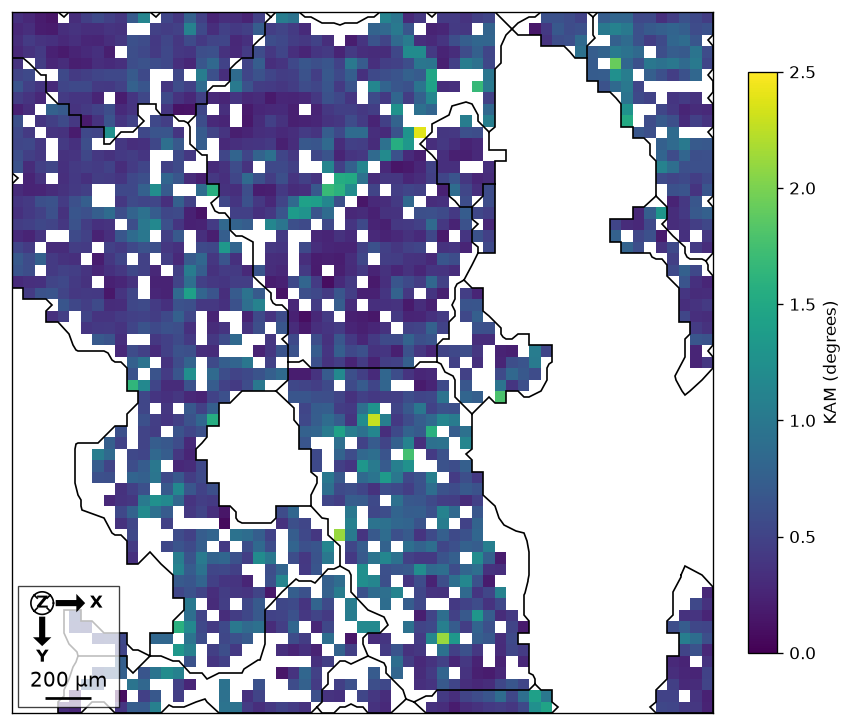
Compute nearest-neighbour KAM within reconstructed Forsterite grains. The small sample is downloaded and cached on first use; all displayed angles are in degrees.
import numpy as np
import matplotlib.pyplot as plt
from mtex import mtexdata, calcGrains, KAM, degree, plot, hold, mtexColorbar

ebsd = mtexdata('small', verbose=False)['Forsterite']
grains = calcGrains(ebsd, angle=10*degree, minPixel=5)
kam = KAM(ebsd, order=1, threshold=2.5*degree)/degree
print('Median KAM (degrees):', round(float(np.nanmedian(kam)), 3))
print('Pixels with no accepted neighbour:', np.count_nonzero(~np.isfinite(kam)))
plot(ebsd, kam, colorRange=(0, 2.5))
mtexColorbar(title='KAM (degrees)')
hold(True)
plot(grains.boundary, lineWidth=1)
hold(False)
plt.show()
calcGrains stores grain ids on the map, so comparisons across its grain boundaries are excluded. The threshold additionally rejects individual neighbour pairs above 2.5 degrees. KAM depends on scan spacing, neighbourhood and noise; it is not itself a strain measurement.
Median KAM (degrees): 0.509
Pixels with no accepted neighbour: 30
Signature
KAM(x, *args, **kwargs)
Methods it calls
| EBSD | the kernel average misorientation: the mean misorientation angle of every pixel to its neighbours |
| EBSD3 | the kernel average misorientation of a volume: the mean misorientation angle of every voxel to its neighbours |
Citing this page.
This page is part of the documentation of
MTEX, a free and open
source MATLAB toolbox for analyzing and modeling crystallographic textures.
It was written by The MTEX Developers and is published at
https://mtex-toolbox.github.io/KAM_py.html.
If you use MTEX, or reuse text or figures from this page, in your research,
please cite
F. Bachmann, R. Hielscher, H. Schaeben: Texture Analysis with MTEX - Free and Open Source Software Toolbox, Solid State Phenomena 160 (2010), 63-68. 10.4028/www.scientific.net/SSP.160.63
BibTeX
@article{bachmann2010mtex,
  author  = {F. Bachmann and R. Hielscher and H. Schaeben},
  title   = {Texture Analysis with MTEX - Free and Open Source Software Toolbox},
  journal = {Solid State Phenomena},
  volume  = {160},
  pages   = {63-68},
  year    = {2010},
  doi     = {10.4028/www.scientific.net/SSP.160.63},
  url     = {https://doi.org/10.4028/www.scientific.net/SSP.160.63}
}
Other papers describing specific MTEX methods are listed under Publications — please cite the one that best fits your application. The MTEX source code is licensed under the GNU General Public License v2.0; the text and figures of this documentation are licensed under CC BY 4.0, which permits reuse — including by automated systems — provided The MTEX Developers and this page are credited.