
function to fit Bingham parameters
Description
confidence ellipse for the mean direction based on Tanaka / asymptotic covariance of the maximum eigenvector (1999) https://doi.org/10.1186/BF03351601
Syntax
BS2 = S2FunBingham.fit(v)
[BS2, ab, rot] = S2FunBingham.fit(v,'p',0.95)
Input
| v | vector3d |
Options
| p | confidence level p of the ellipse computed (default at 0.95) |
Output
| BS2 | S2FunBingham |
| ab | semi axes length of the confidence ellipse (in radian) |
| rot | orientation of the confidence ellipse, to be used with |ellipse| |
Example
simulate some directions
v = discreteSample(S2FunBingham([-10 -4 0]),50);fit a Bingham distribution
[S2F, ab, rot] = S2FunBingham.fit(v)S2F = S2FunBingham (y↓→x)
ab =
0.1062 0.2124
rot = rotation
Bunge Euler angles in degree
phi1 Phi phi2 Inv.
8.45587 170.693 15.2773 1visualization
plot(S2F)
mtexColorMap LaboTeX
hold on
plot(v,'Markercolor','k','MarkerSize',3)
ellipse(rot,ab(1),ab(2),'linewidth',2)
hold off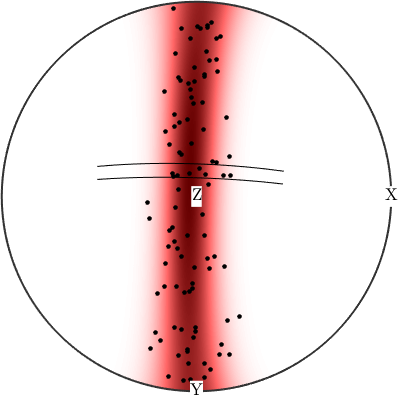
Citing this page.
This page is part of the documentation of
MTEX, a free and open
source MATLAB toolbox for analyzing and modeling crystallographic textures.
It was written by The MTEX Developers and is published at
https://mtex-toolbox.github.io/S2FunBingham.fit.html.
If you use MTEX, or reuse text or figures from this page, in your research,
please cite
F. Bachmann, R. Hielscher, H. Schaeben: Texture Analysis with MTEX - Free and Open Source Software Toolbox, Solid State Phenomena 160 (2010), 63-68. 10.4028/www.scientific.net/SSP.160.63
BibTeX
@article{bachmann2010mtex,
  author  = {F. Bachmann and R. Hielscher and H. Schaeben},
  title   = {Texture Analysis with MTEX - Free and Open Source Software Toolbox},
  journal = {Solid State Phenomena},
  volume  = {160},
  pages   = {63-68},
  year    = {2010},
  doi     = {10.4028/www.scientific.net/SSP.160.63},
  url     = {https://doi.org/10.4028/www.scientific.net/SSP.160.63}
}
Other papers describing specific MTEX methods are listed under Publications — please cite the one that best fits your application. The MTEX source code is licensed under the GNU General Public License v2.0; the text and figures of this documentation are licensed under CC BY 4.0, which permits reuse — including by automated systems — provided The MTEX Developers and this page are credited.